
Updated on February 9th, 2025 by Kenneth Ojeisekhoba
OXERBLOG > BLOG > HOW TO DEVELOP AN EFFECTIVE SEO STRATEGY
Disclosure: Oxerblog relies on its readers’ support through referral links. I may earn a commission for some of them, at no additional cost to you.
Every website that wants to succeed in Organic Search today needs to create an effectively robust SEO strategy.
An SEO strategy helps you to set up an efficient process for creating the type of content (and pages) that search engines love to rank and users love to read.
A robust SEO campaign is usually based on painstaking research including your target audience’s search queries and keyword intent.
It also includes Google’s current best practices and recommendations for improving your site’s overall SEO, among other things.
So, an effective SEO strategy is a robust plan for constantly creating quality content and delivering a great user experience.
Its goal is to increase your site’s visibility in organic search engine result pages (SERPs) so you can get more relevant traffic, higher pageviews, more conversions, and increased sales.
This can also establish you as an authority in your industry or niche.
So once you start a blog or website, you should develop an SEO strategy.
What is An SEO Strategy?
An SEO strategy is a series of legitimate steps that you need to take to consistently publish great content that matches user intent to push up your organic rankings and improve your search (and business) metrics.
And statistics show that the higher your position in search results, the more organic click-through rate (CTR) you receive (Backlinko).
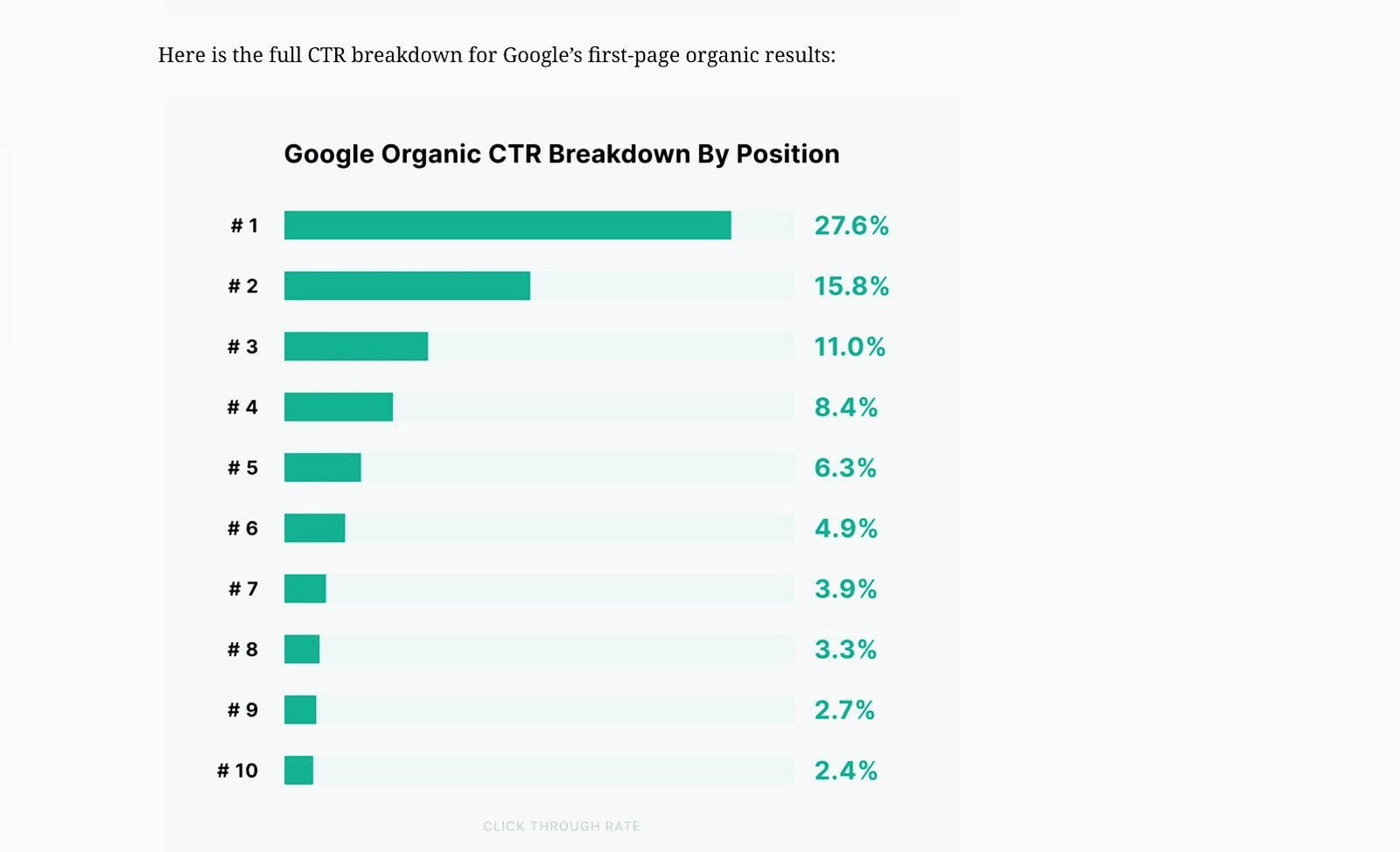
So, whatever the type of site you create and whichever niche you’re in, building a robust SEO strategy is essential for your success in organic search results.
Why Is It Important to Create an SEO Strategy?
Developing an SEO strategy enables you to follow a detailed but streamlined plan to constantly create content that is properly optimized for search engines.
First, 53% of all website traffic comes from Organic Search, according to BrightEdge.

That said, only leading websites in organic search results enjoy that privilege.
Now, no website can do well in search engines without investing in a robust SEO strategy.
Second, an SEO strategy helps you to consistently write your articles with clarity and precision, the kinds that are a pleasure to read, because your content matches search intent.
It also helps you to focus on providing a good page experience that makes user interaction with your content seamless and engaging.
To put it in another way, an effective SEO strategy enables you to sort the grain from the chaff, so you can hone in on the most efficient steps you need to take to grow your website.
Third, creating an SEO strategy also enables you to develop and sharpen your SEO skills.
When you consistently produce content that is optimized for SEO over time, you become an expert at it.
How to Design an Effectively Robust SEO Strategy
A robust SEO strategy begins and ends with users.
Google puts it so well: “Find out what your readers want (and give it to them)” – just as they would like.
And if they like it, they’ll spend more time with it, which is a signal to Google that your content is the real deal. So search engines will simply continue to serve your pages to users’ queries.
So, an effective SEO campaign focuses completely on readers, from start to finish, and not on search engines.
In any case, search engines exist to serve users better.
Now, for it to produce the best results, your SEO strategy has to be all-encompassing – from research to implementation to delivery, to continuity.
In this post, I’ll show you 9 critical steps you should take to develop an effectively robust SEO strategy to improve your rankings and traffic in just a couple of weeks.
Below is a list of contents we’ll cover in this article.
Table of Contents
1. Choose A Niche That Is Your Area of Expertise
2. Find Your Target Audience’s Keywords
4, Create Enough High-Quality Content
7. Invest In A Good Content Design
8 Optimize for Quality User Experience (UX)
9. Constantly Evaluate and Fine-Tune Your SEO Strategy
▪ Frequently Asked Questions (FAQs)
Now, let’s get started.
How To Create An Effective SEO Strategy in 9 Steps
❶ Choose A Niche That Is Your Area of Expertise
The first step to developing an effective SEO strategy is to pick a niche that is your area of expertise.
Here is why.
Among other things, Google identifies the level of Experience, Expertise, Authoritativeness, and Trustworthiness (or E-E-A-T) to rate the quality of every page and website in all niches.
It simply means that no matter how great your content is, Google will rate it low, if it does not have the level of E-E-A-T required for the topic.
Let’s break it down.
The 4 characteristics of E-E-A-T that Google evaluates for the purposes of Page Quality rating include:
▸ The first–hand experience of the creator − i.e. how much ‘everyday’ expertise you have to create the content.
▸ The expertise of the creator – i.e. the level of your formal expertise relative to the content.
▸ The authoritativeness of the creator, the content itself, and the website – i.e. how accurate, correct, or truthful you, your content, and your website are.
▸ The trust of the creator, the content itself, and the website – i.e. how reliable or dependable you, your content, and your website are.
While E-E-A-T isn’t a direct ranking factor, it is an integral part of Google’s Page Quality rating, and by extension, user experience signals.
This, among other factors, informs which results Google ranking algorithms serve to a search query.
So, you must have the requisite expertise or life experience to produce content about the topic that can be trusted.
If not, Google will not rate your content high which, in turn, affects your visibility in search results.
According to Google, “high-quality pages and websites need enough expertise to be authoritative and trustworthy in the topic.”
So, they assess the level of E-E-A-T required for a page to achieve its purpose well, before selecting an overall Page Quality rating.
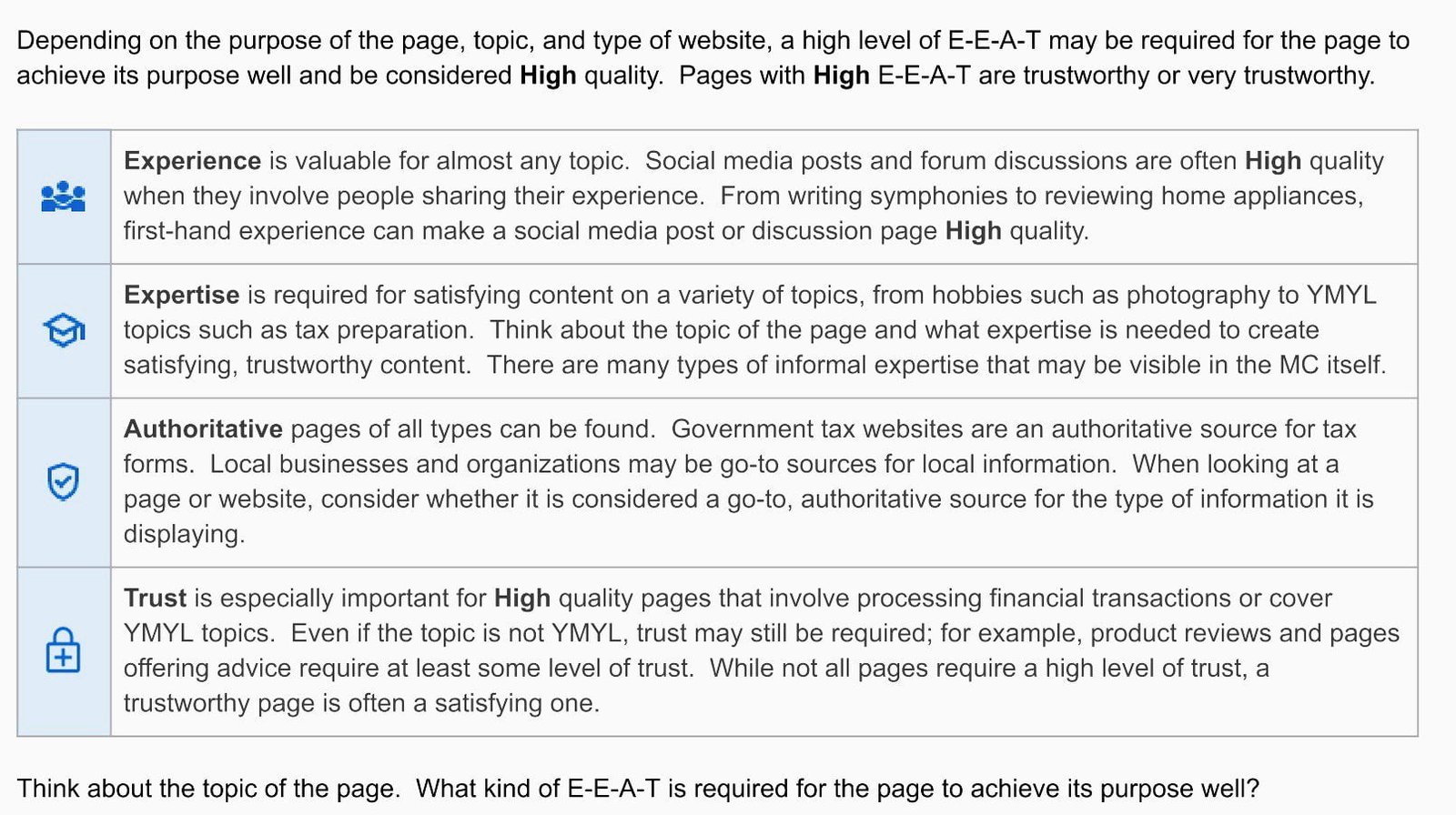
They want to know if you’re an expert in the niche, including what makes your source dependable, your site highly accurate for the topic, and your content trustworthy.
So the topic determines the level of expertise needed to produce the page.
You must have either adequate formal expertise or ‘everyday’ expertise born out of first-hand experience.
So based on the sensitivity of the topic, Google has grouped niches into two categories:
1. Highly sensitive niches aka “Your Money or Your Life” (YMYL) topics: that require higher standards, and so, mandatorily, you must have the proper formal expertise and certification.
2. Less sensitive niches: that require less formal expertise or “everyday expertise” gathered from life experiences.
In other words, Google expects “all types of pages and websites to be created by people and organizations with the appropriate expertise” whether a YMYL topic or a less sensitive niche.
So, there are “expert” websites of all types, including gossip websites, fashion websites, humor websites, Q&A websites, etc. And only these kinds of websites rank high in search results.
Your SEO strategy should, therefore, begin with choosing a niche that is your area of expertise.
Having a passion or knowing a lot about a field in the YMYL group cannot qualify you or make up for a lack of formal expertise and certification that it requires.
So for example, according to Google, a web page not written by a suitable qualified medical professional will be regarded as misinformation or quack advice.
Also, for a humor or cooking website, you still have to prove to Google that you have the less formal expertise (or experience) required for your content to stand a chance to appear on page 1 of search results.
The bottom line is that whatever niche you’re in, you should have the required expertise for the topic and the website you create.
For more details, see my article on how to choose the perfect niche for your site.
Once you settle your area of expertise, the next thing is to find the words and phrases that users are searching for in the niche.
❷ Find Your Target Audience’s Keywords
Search queries (or keywords) are the main building blocks of any robust and successful SEO strategy.

So, for your SEO campaign to be successful, you need to find keywords that readers in your niche are typing into search engines.
No matter your expertise, you cannot put pen to paper without first knowing what your target audience is searching for.
And that includes coming up with topics to write about.
You need to research your audience’s exact keywords before anything else.
● Start with keyword research
While keywords are the building blocks of any effective SEO strategy, keyword research is the starting block.
Keyword research is the process of discovering and cracking your target users’ exact words, phrases, and questions entered in search engines.
So, keyword research involves two critical steps:
1. Finding your audience’s exact queries − i.e. search keywords, and
2. Finding out exactly what they want to know about each keyword − i.e. the search intent.
Keyword research is a painstaking process, but it is what you need to do to create the kind of content people love to read.
The best educated guesses cannot be as accurate as keyword research.
● How to do your keyword research
The easiest way and the best place to begin your keyword research is in search engines themselves. And you’ll want to start with the most popular search engine in the world, Google.
Start from page 1 of search results; it is a goldmine for bloggers and content creators.
To get started, simply think up a few likely words your target readers would type into Google’s search field.
Once you start typing, a pull-down menu of suggestions will appear.
These suggestions are the actual search queries of Google users in your niche.

After every letter, word, and space you enter, Google will show a list of suggestions.
As you continue to type, longer queries will come up.
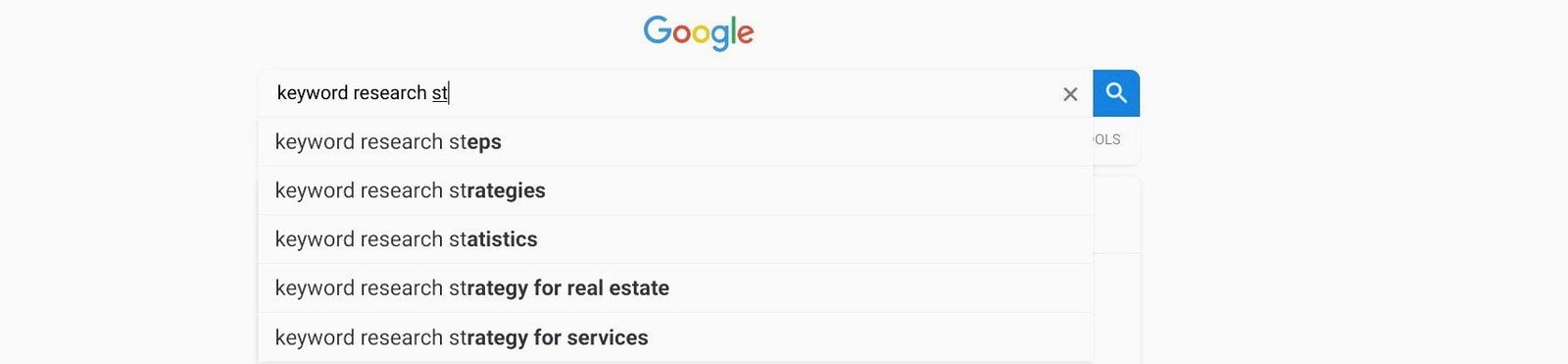
This keyword research tool is known as Google Suggest (or Autocomplete).
Again, these are the exact keywords of Google users; so they are 100% accurate.
You can find short, medium, and long keywords using this tool.
Next, write down all the queries you can find.
Use this method to gather different queries your audience is searching for.
The second easiest way and next best place is to look at the leading websites in your niche.
Find the exact keywords they’re ranking for with SEO tools like Ubersuggest, SEMrush, AnswerThePublic, Ahrefs, and Moz.

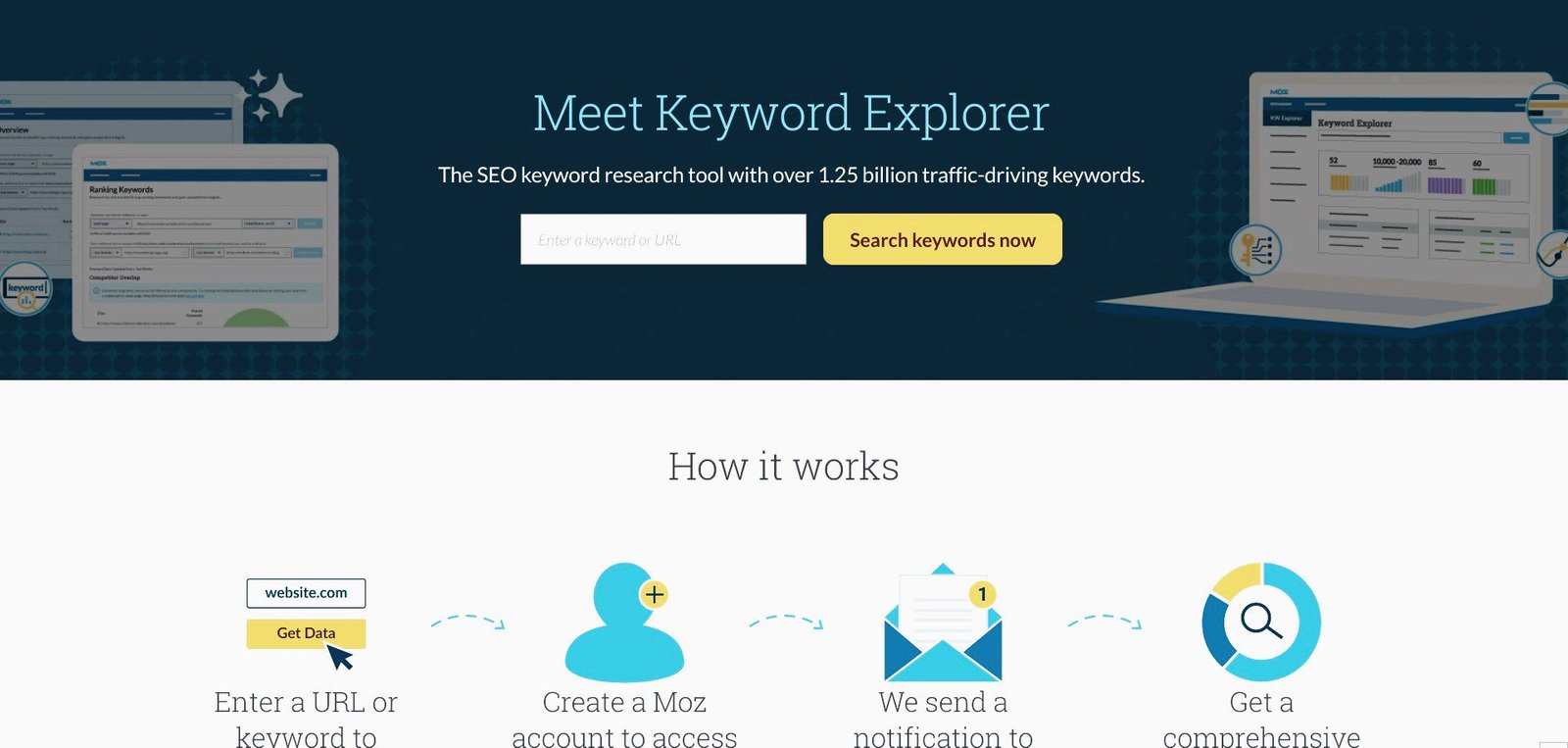
Simply type a top website’s domain name into any of these tools, and they will show you the keywords they’re ranking for.
The third place to do your research is in Exploration features aka People also Ask, People also search for and Related searches on page 1 of SERP.
You’ll discover several related keywords people also want to read about in these places.

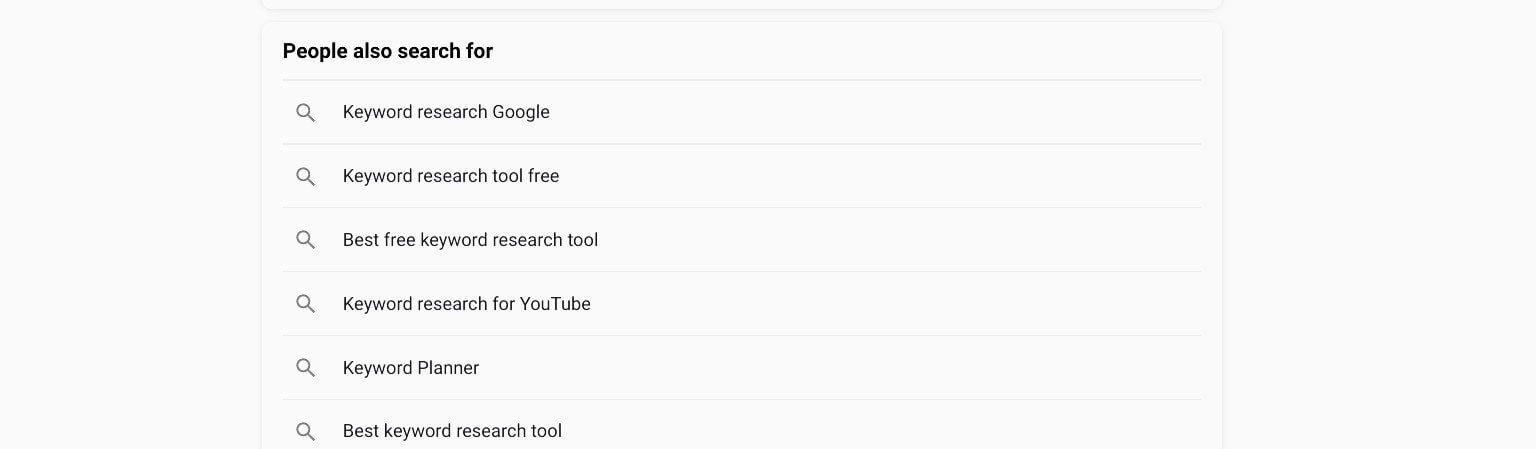
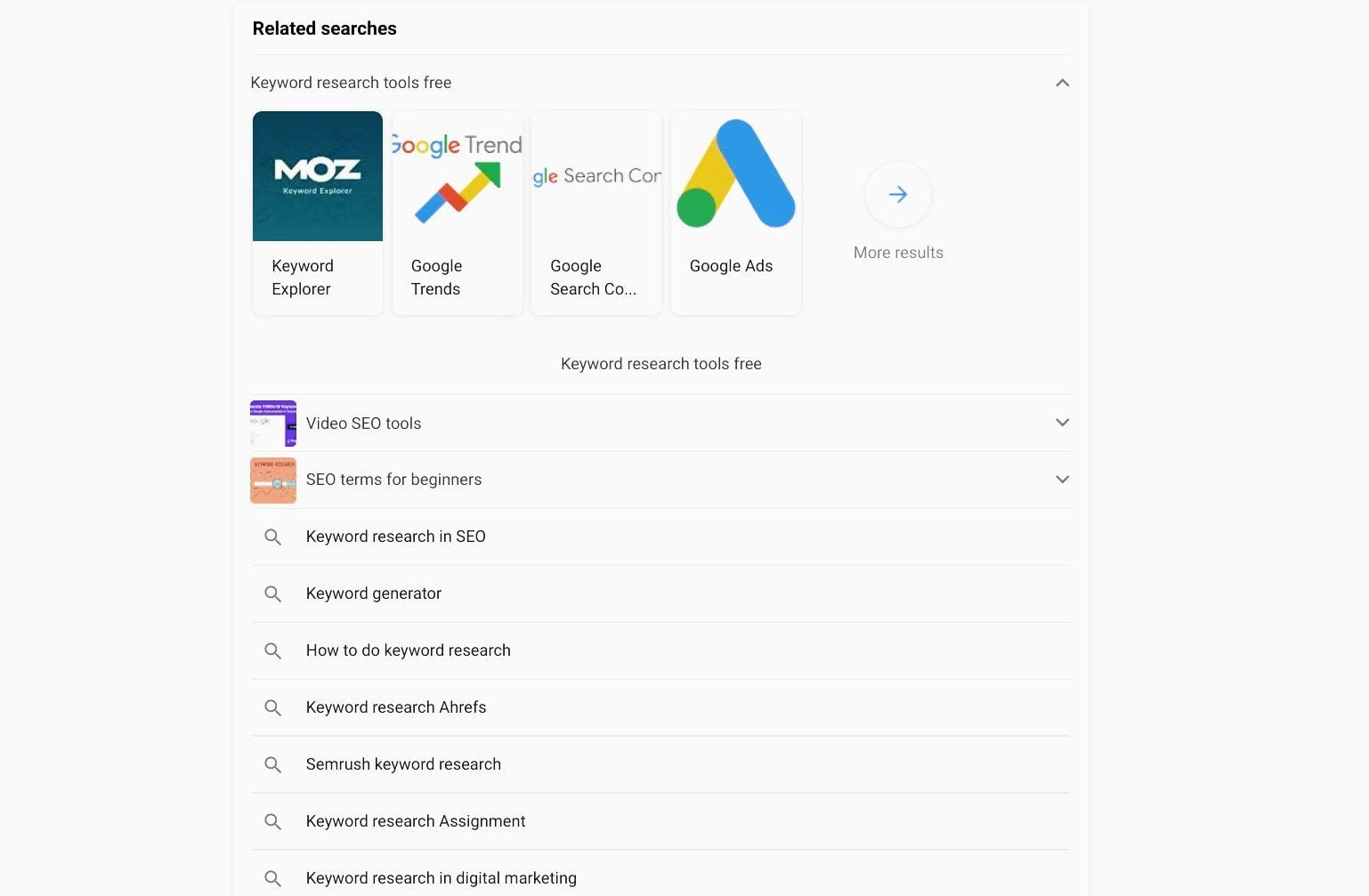
Again, the keyword ideas in these sections are actual queries entered into Google.
They have a high search volume, that’s why Google features them on page 1 to help searchers expand and refine their initial search.
That said, content creators can also find more keywords to create more robust content for users.
● Compile keyword variations and synonyms
Readers type several variations and synonyms of a keyword into search engines.
For example, the keyword “how to start a blog” can also be written as “how to create a blog”, “how to build a blog”, “how to make a blog”, and “how to set up a blog”.
Search engines recognize that all these queries mean the same thing. So, you want to compile all the variations you find for each keyword.
For example, if you were writing on “how to start a blog”, not to make it monotonous and repetitive, you want to use these variants in your content.
Therefore, your list of queries should include variations and synonyms for each keyword.
This will make your writing richer and help users and Google better understand the overall topic of each page.
By now, you should have a long list of keywords.
Next, find out what searchers really want to know about the keywords. This is the crux of the matter. It is known as search intent.
● Write out the search intent
Search intent is simply the meaning of or the reason for a given query. In other words, the context of the words in the query.
People usually search for something specific, especially for longer queries.
You should invest time in cracking these keywords. It is probably the most significant investment you’ll make in developing your SEO strategy.
Understanding the intent behind a query puts you on the same wavelength as Google RankBrain.
First, check what answers already exist in SERPs. Note the results that are dominating page 1 for each keyword.
You want to study these search results carefully and take your cue from them.
Second, note the format(s) that is ranking for each keyword.
Because search intent also includes the content format(s) that users prefer the information in.
The results on the first page have remained on top because search engines have noticed that searchers love both the content and the format(s) they’re written.
And as long as they continue to get more visits, low bounce rates, and more dwell time, they’ll continue to rank.
Generally, the popular content types that work best for SEO strategies include blog posts, evergreen content, long-form content, how-to guides, infographics, videos, case studies, and original research.
Next, write out your understanding of the words and concepts of each keyword.
Mark those you think you understand very well and can answer comprehensively and differently from what is already available in search results.
Also, research if anything is missing that’s relevant and will help people’s understanding of the topics. These are great opportunities you can exploit.
It could be new and original information, insightful analysis, research, or reporting.
❸ Sort Your Best Keywords
Once you’ve gathered enough search queries that you can make sense of, the next thing to do is to sort your best keywords.
Start by finding out the search interest in each keyword on your list.
The first tool I recommend you use is Google Trends owned by Google.

This tool will show you how high (or low) and how consistent the search interest in a keyword is over a period – the past hour, 4 hours, past day, 7 days, 30 days, 90 days, 12 months, 5 years, etc. You can customize the time range as well.
You can also compare up to 5 different keywords to find which one has the highest search interest in a particular time frame.
Keywords with consistently high search interest over time can be considered for pillar content.
There is already a big audience searching for these keywords all year round.
Google Trends will also show you interest by region – if it is worldwide, by regions (i.e. countries), and if it is country, by subregions (i.e. states).
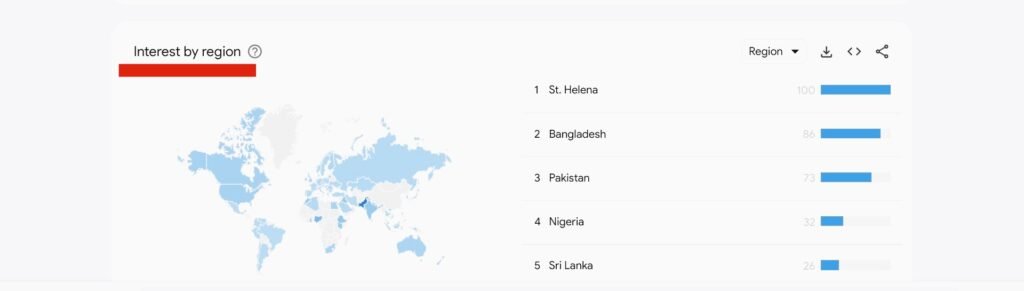
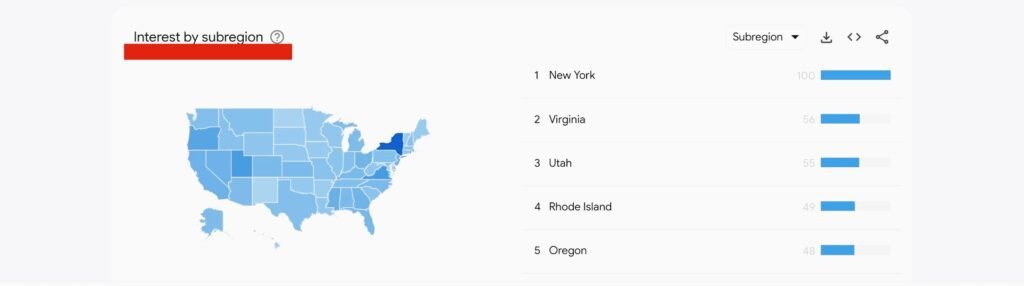
It will also suggest other related topics/queries you may want to check out.
You can do more research on your list of keywords with the SEO tools I mentioned earlier, to know the estimated monthly search volume.
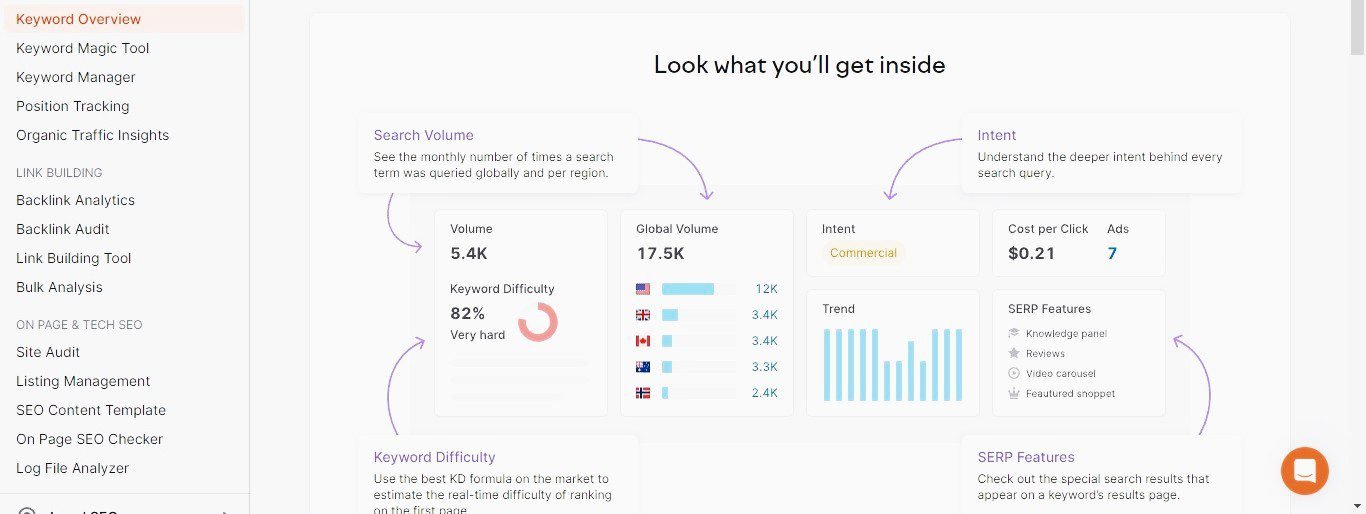
These tools will also help you analyze the competition and give you more content ideas, among other things.
● Your best bet
From your list, pick your best keywords.
Your best bet is search queries with low competition you can provide adequate experience, expertise, authoritativeness, and trustworthiness (E-E-A-T) for, and so can answer well and easily rank.

That said, you also want to select competitive keywords you know you can offer something new or different.
Google will be the first to tell you that not all the answers have been provided on the web for many queries.
Nick Fox, a top Google official, said: “Most queries don’t have a single answer – they’re often open-ended questions…”
So, once you have the expertise and can offer new insights that help readers better understand the topics, select queries with multiple interpretations and add them to your list of best keywords.
● Create a list of topics
Now that you have sorted your best keywords, create a list of the titles of the articles you want to write about.
The best SEO practice is to focus on one lead keyword per topic.
That way, search engines can tell the keyword you want to rank for, for a particular page.
Make sure the title of each article includes your main keyword and reflects the actual content of the page. Google also considers this in its Page Quality rating.
Very importantly too, the topic should reflect the search intent of the keyword in a few words.
❹ Create A Satisfying Amount of High-Quality Content
For any website, enough high-quality content is the key driver of an effectively robust SEO strategy.
First, Google says every page you create should have a specific purpose defined by the search intent of your lead keyword.
Again, once you know what your target readers want, give them the most comprehensive information possible.
“Creating compelling, exhaustive, and useful content will probably have the greatest influence on your website traffic than any other factor”, says Google.
In other words, nothing will drive traffic to your site like solid content.
Users love to read good content and will most likely recommend it to others on their blog posts, social posts, emails, online forums, and by word of mouth.
And search engines love to rank great content to satisfy their users.
Moreover, as Google said, nothing builds your site’s reputation faster with users and search engines like creating a satisfying amount of high-quality content (consistently).
A satisfying amount of high-quality content is among Google’s top 3 ranking factors.
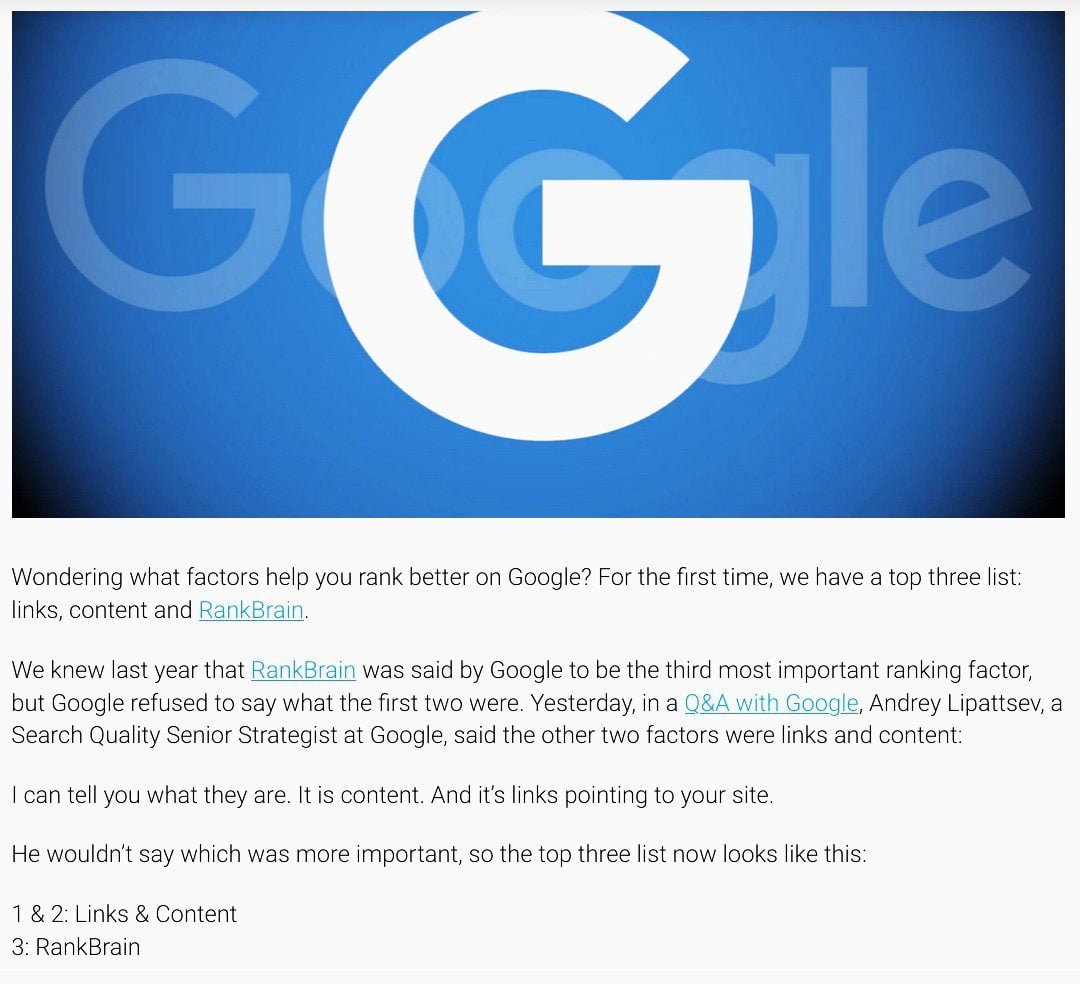
So, detailed quality content will improve your Page Quality rating score more than any other factor.
Google says it will rank useful and relevant content with subpar page experience higher than a poorly-written article with a good page experience.
How much more beneficial content with a great page experience.
Having said all that, as Google said, for all websites, it takes a good bit of one of the following to write rich, quality content: effort, originality, talent, or skill.
So, what is enough high-quality content?
Enough high-quality content is adequate information and well-written content that satisfies the topic and is very beneficial to readers.
In other words, the topic and purpose of a page determine how much information is needed for the page to be termed high-quality and satisfying.
In Google’s own words, for example:
High-quality information pages are expected to be factually accurate, well-drafted, and exhaustive.
High-quality shopping content is expected to help people find the products they want, and purchase them easily, and
High-quality comedy is expected to be entertaining to the target audience.
So, according to Google, “a high-quality page on a broad topic with a lot of available information will have more content than a high-quality page on a narrower topic.”
Therefore, depending on the topic and beneficial purpose of the page, you’ll be creating high-quality, long-form content as well as high-quality, short- and medium-form content.
● Construct your content with your keywords
The most basic signal Google uses to identify pages that are relevant to a query is they contain the same keywords as the search term.
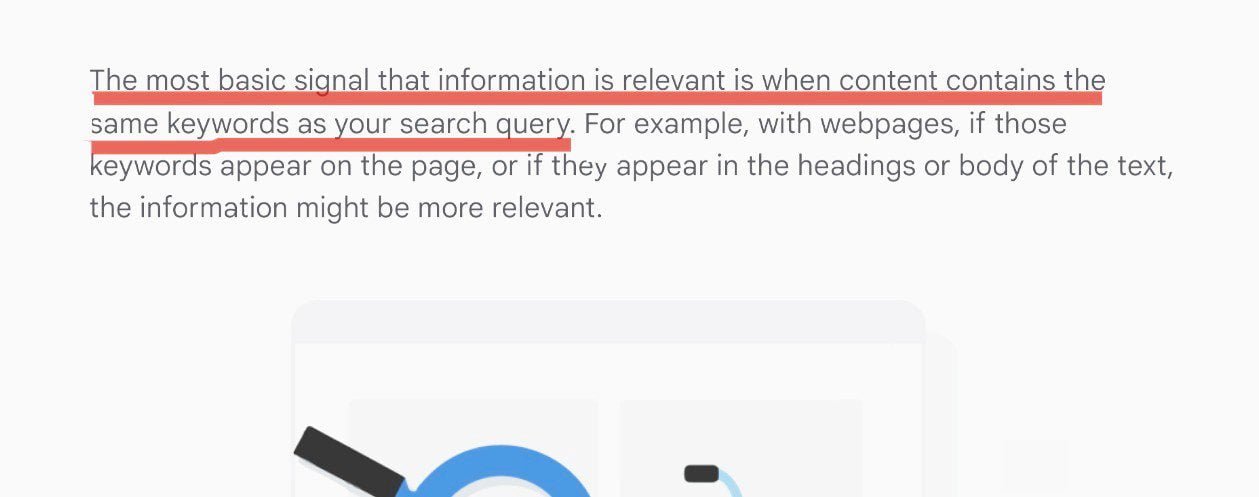
Since you’re writing about what your readers are searching for, it’s only natural to include their keywords in your content.
Place your main keyword seamlessly in a few important places such as the title, main heading, and around your content when it makes sense.
The days of stuffing keywords to rank high are gone. Today, Google will penalize anyone who goes overboard.
Instead, you want to concentrate on giving users the best information about what they want to learn about the topic.
Also, include the keyword variations and synonyms (you’ve gathered earlier) naturally. It would make for richer content.
The bottom line is to create gratifying and easy-to-read content that users will enjoy.
Remember to cite your sources, and show evidence of E-E-A-T for your pages and website.
❺ Do More On-Page SEO
Creating high-quality content that matches your target readers’ search intent is the most important on-page (or on-site) SEO.
However, there are more on-page SEO techniques you need to apply, to make your campaign very effective.
These are legitimate and basic SEO best practices recommended by Google to help users and search engines easily find and better understand your pages.
Below are a couple of them:
● Start your page title with your lead keyword
It is good practice to include your main keyword in your page (or post) title, aka ‘title tag’.
The impact of this on SEO is, however, strongest when you frontload it; that is when you place it close to the beginning of your title tag.
That way, search engines can easily see it, and this makes for good rankings.
On the other hand, the effect of your keyword on page titles wanes as you push it into the background.
So, as much as you can, start your title tag with your lead keyword.
Again, your page title should reflect the search intent of the keyword and the content of the page.
A page’s title tag is very different from its title link.
If your page appears in search results, the title tag could be the source of the clickable title link.
The most effective title tags are usually between 40 and 60 characters long, according to experts.
● Create high-quality text for your title links
A title link is the title of a search result on a SERP that searchers can click on to view the page.
For example, here is what the title link for this post will look like:
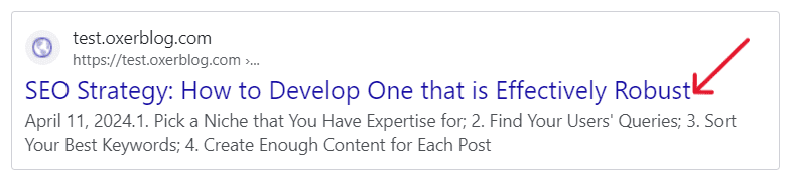
Your title link should provide users with a quick insight into the content of a result and the reason it is relevant to their query.
Google automatically selects a page’s title link from various sources. They include:
▸ Content in your title tag
▸ Main visual title shown on the page
▸ Heading elements such as the main heading
▸ Text within links that point to the page
▸ Anchor text on the page
▸ Other content on the page
However, Google says you can influence your title links and indicate your preferences if you follow their best practices.
The title link is usually the primary piece of information readers use to decide which result to click on.
That’s why Google says you should use high-quality title text in your content.
● Create a unique URL using your lead keyword
A URL is the permanent address of each piece of content on your site.
The best practice is to have a different address for each page, image, video, and every other content.
Since every page is about one main keyword, include it in its unique page URL.
For example, The primary keyword for this page is seo strategy. So its URL is:
https://www.mydomainname.com/develop-a-robust-seo-strategy/
No other page has this same address on my website.
So, this makes it easy for search engines to quickly identify, crawl, index, and match it to the exact or related query.
Finally, it should be as short as possible to make it search-friendly.
● Write a unique meta description tag for each page
Your meta description is usually a brief summary of what the page contains, say about 160 characters.
It is another on-page element that search engines read to understand the content of a page.
Your meta tag can appear as a snippet in SERP which can help improve your CTR.
So, write a different description for each page.
For example, here is what the meta description tag for this post will look like:
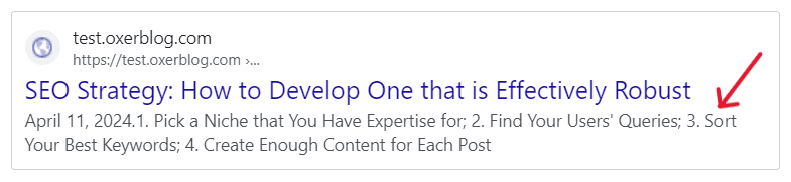
Add your main keyword and every important detail that is a unique selling point of the page.
● Create a chain of internal links among all your important pages
Linking your important pages together is also very helpful for SEO. Especially when you connect your new or unknown pages to your popular related content.
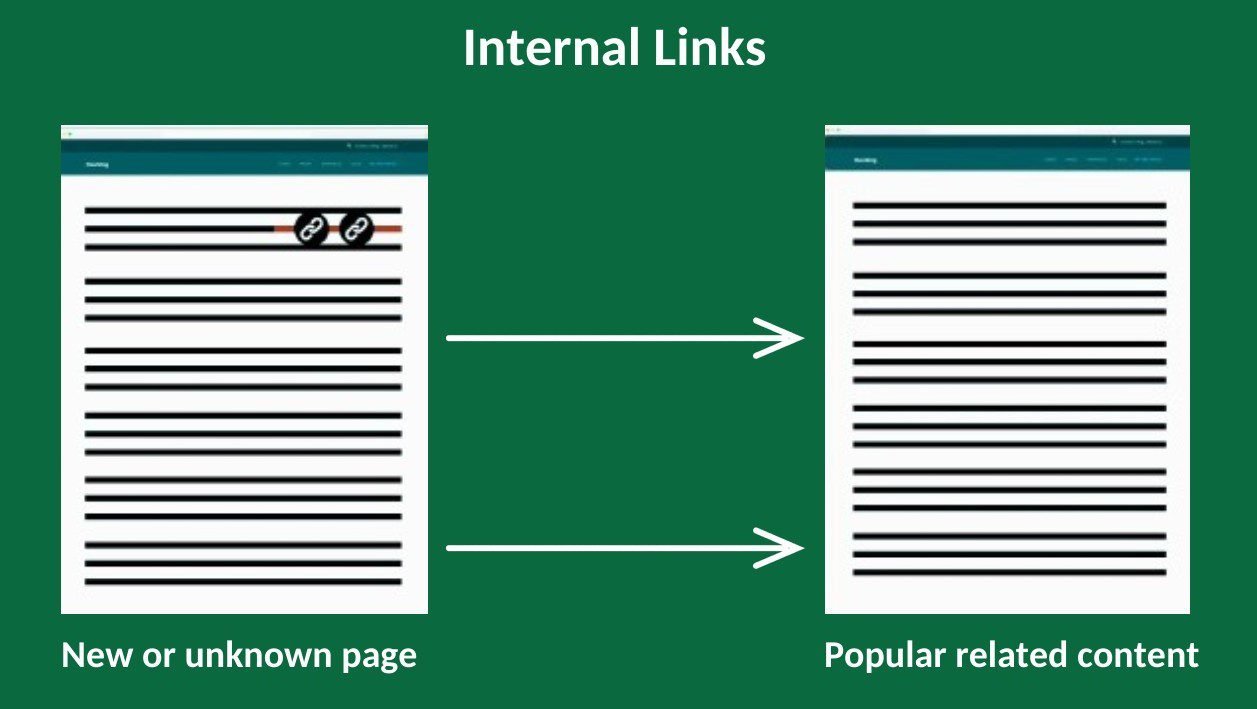
Internal linking best practice is to start from your homepage (typically the most-visited page) to your most important pages (or pillar content).
Then link to other pages with related content to help readers learn more about a particular topic.
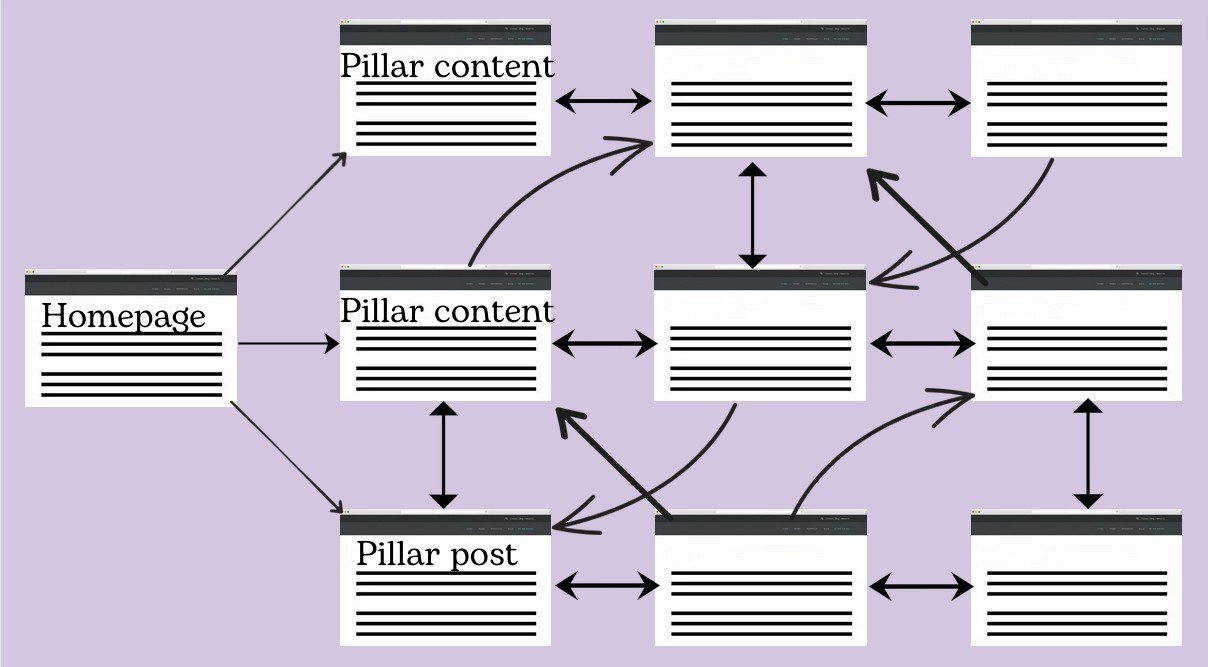
First, Google uses your chain of internal links to determine the relevance of pages and as a road map to discover other content on your site.
Second, they encourage readers to navigate your site and explore all your important content − which can improve user dwell time.
And when readers spend more time on your site, it says to Google that your pages are loaded with quality and relevant content.
However, make sure your links make sense and are well-formatted and clickable.
The link text (or anchor text) should give a basic idea of what the page linked to is all about.
❻ Optimize for Off-Page SEO
Off-page (or Off-site) SEO is simply the candid assessment and approval of your content by other websites that can heavily impact your search rankings.
It includes backlinks (or inbound links), interviews, and getting mentioned on other related sites.
Of all off-page SEO elements, backlinks are the most important and the most effective.
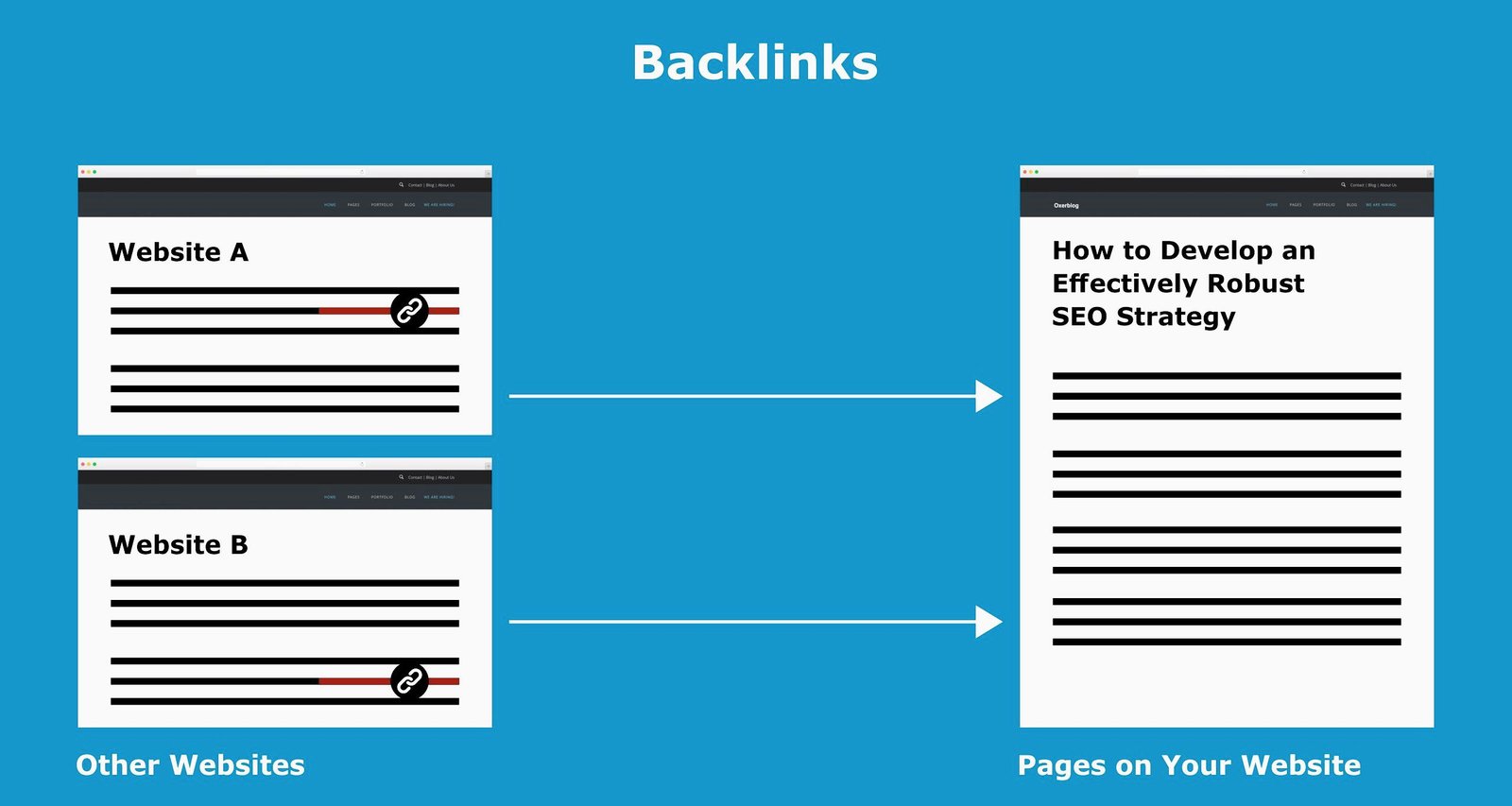
Backlinks are links from other websites to yours, recommending your content to their users to learn more, or pointing to it as their source.
They’re also the most valuable links among the 3 types of links.
Here’s why:
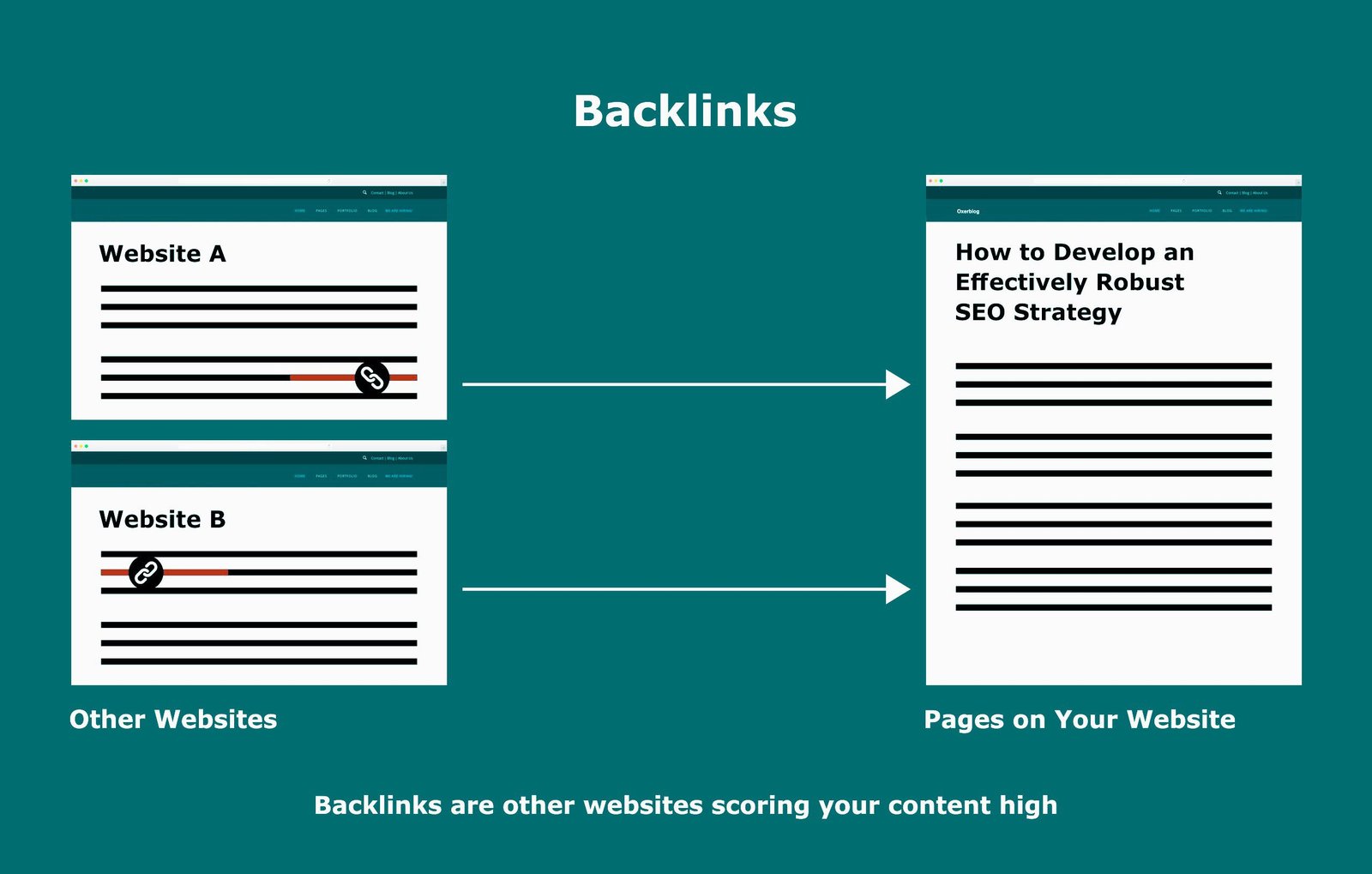
Internal links are you validating your own pages, while external links are you scoring other websites high.
But backlinks are other websites giving your content high marks.
Having said all that, not all backlinks are SEO heavyweight.
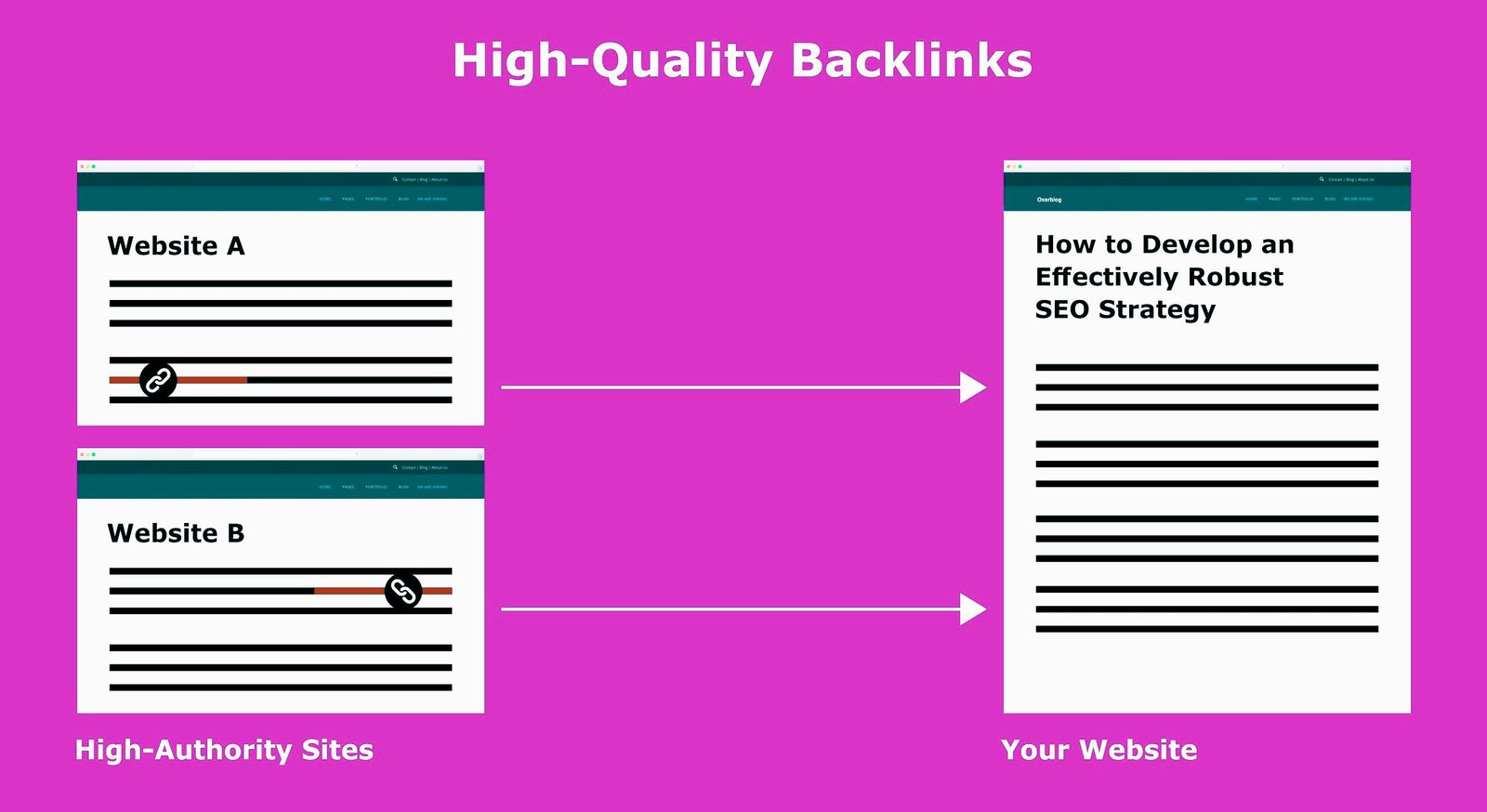
Only links from high-authority sites carry a lot of weight in the eyes of search engines.
They are a signal to them that your site contains content of high repute and value.
In fact, quality backlinks are one of the top 3 ranking factors.

Google uses links from other sites with high domain authority to discover and rank high-quality content.
Meaning the more quality backlinks you get, the stronger your reputation, and the higher your search rankings.
Backlinks don’t only boost your search rankings on page 1 where you can get more clicks, but also attract visitors from linking websites.
So:
● Focus on building high-quality backlinks
The value of a backlink depends on the website it’s coming from, irrespective of the quality of your content.
In other words, the domain authority of the linking website defines the quality of the backlink and not your content.
So, high-quality backlinks originate from established, reputable websites, while low-rated backlinks come from low-ranking sites.
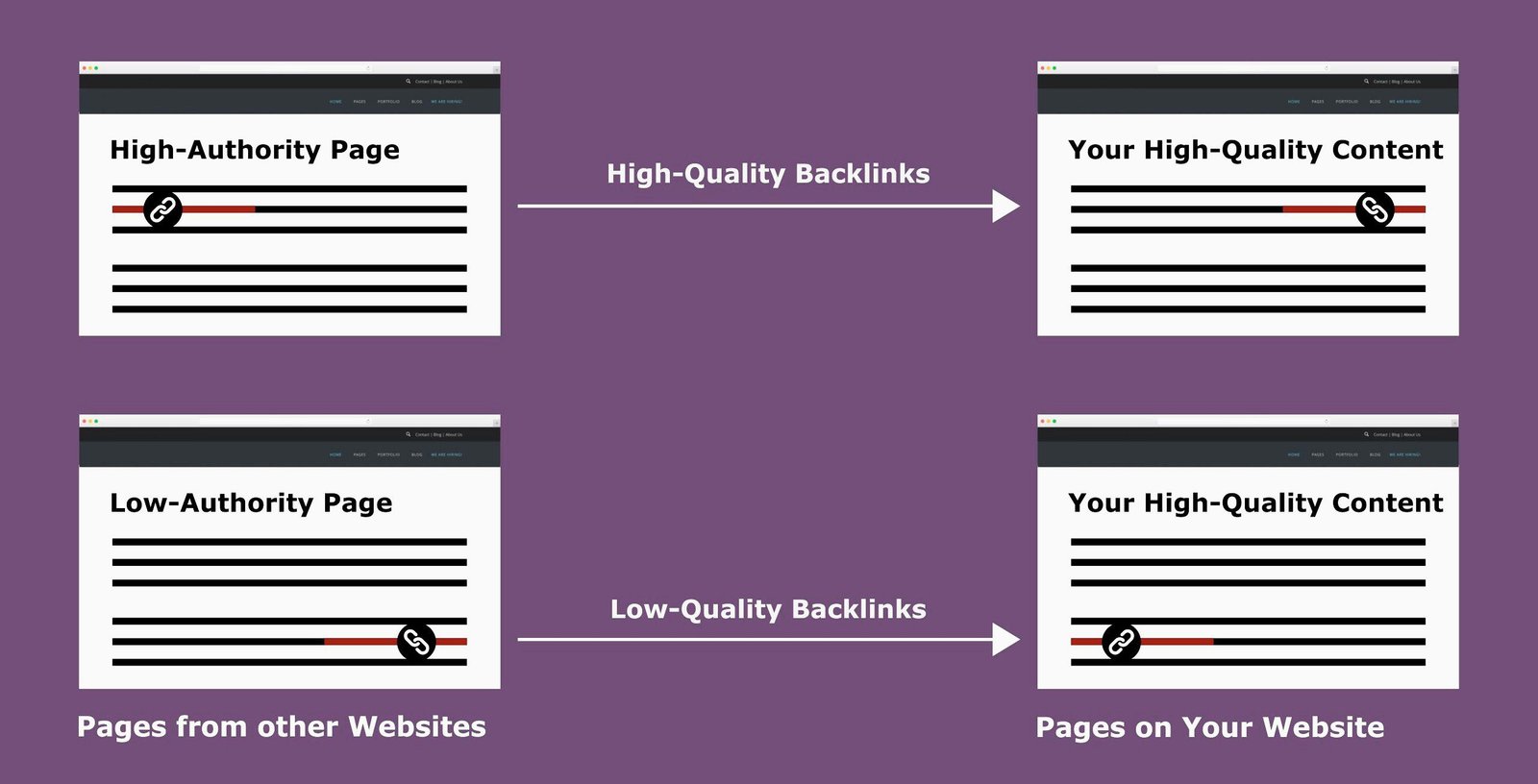
That’s why only high-quality backlinks carry weight.
Again, a website’s reputation defines the quality of the link from it.
As they say, one backlink from a reputable site will improve your ranking better than hundreds of links from unknown websites.
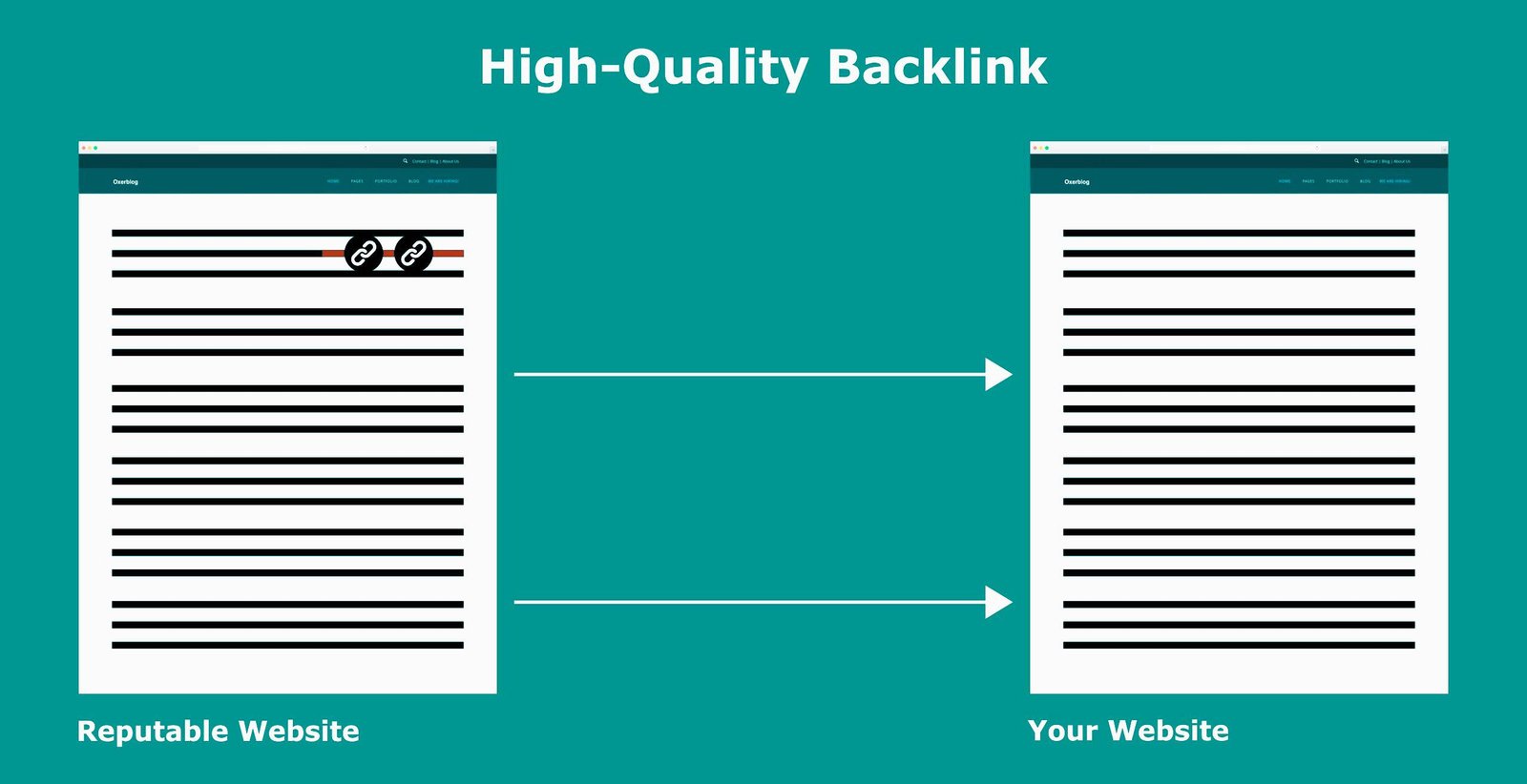
Just imagine the impact of hundreds of backlinks from trusted, popular websites.
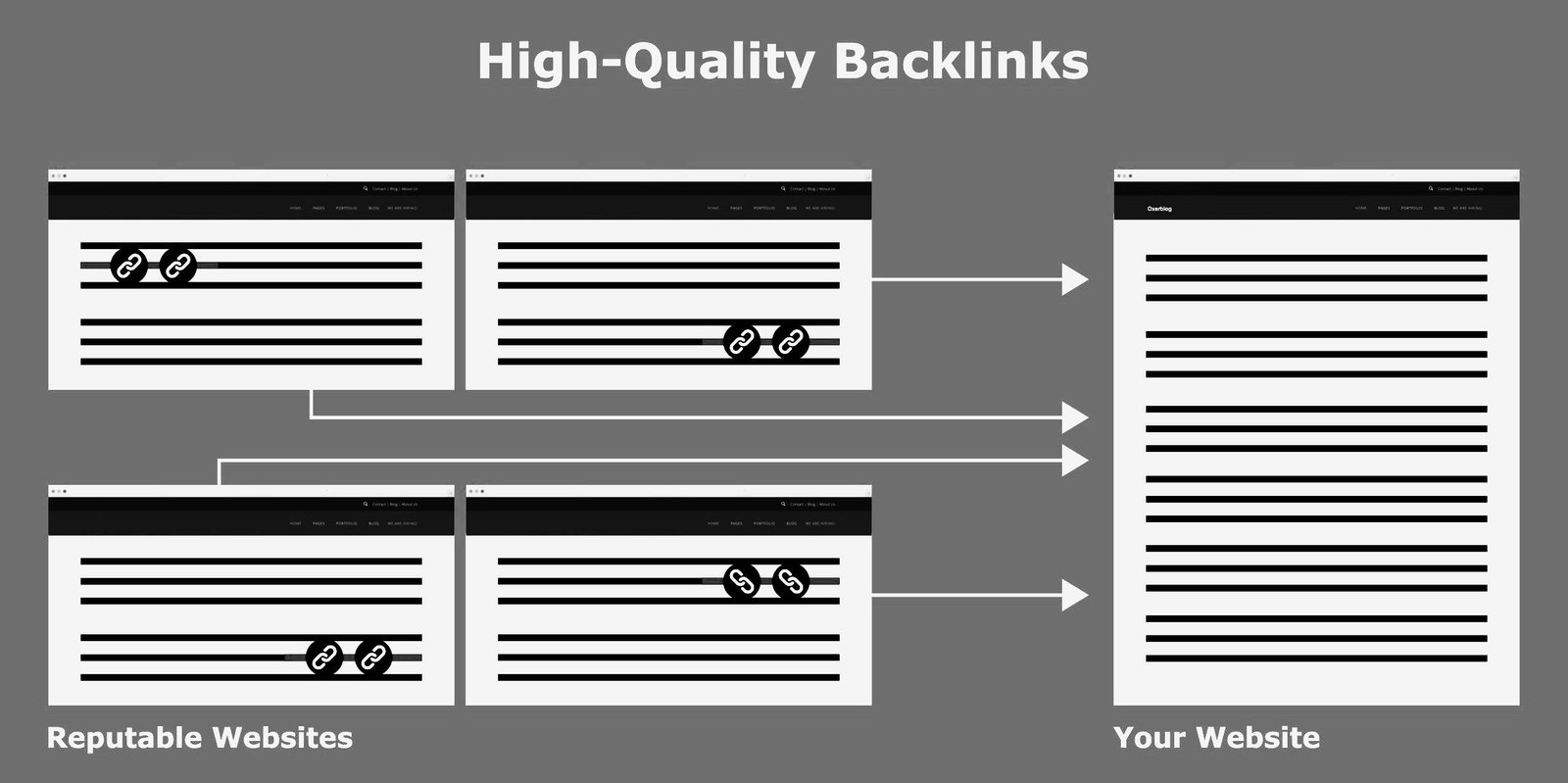
So, focus on building high-quality backlinks (Keep reading, you’ll see how to in a moment).
● Quality backlinks from related content are more powerful
While organic (or natural) links from any respectable site will be considered high quality, backlinks from related pages on reputable sites have the highest quality.
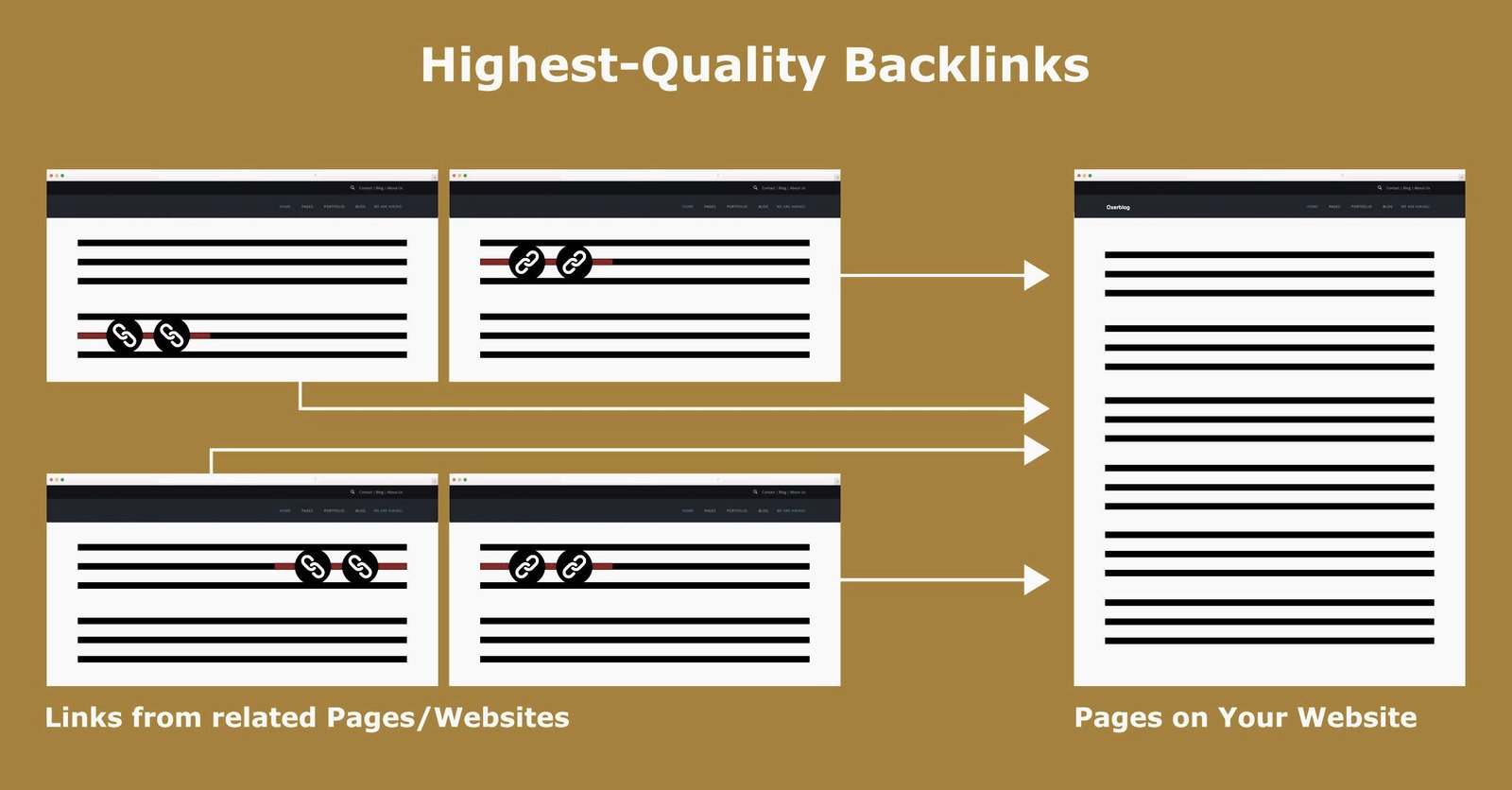
Because they’re from expert websites in your niche, Google sees them as the most valuable and powerful backlinks.
So this class of backlinks has the greatest impact on your website reputation and search rankings.
Nothing can be greater than other experts in your field acknowledging your work.
How to Build High-Quality Backlinks
● Invest resources in linkable assets
A linkable asset is well-researched, valuable content, data, etc. that credible, related sites especially, will be happy to link to, to help their audiences better understand a topic.
That said, certain content formats attract more backlinks than other forms, according to Backlinko.
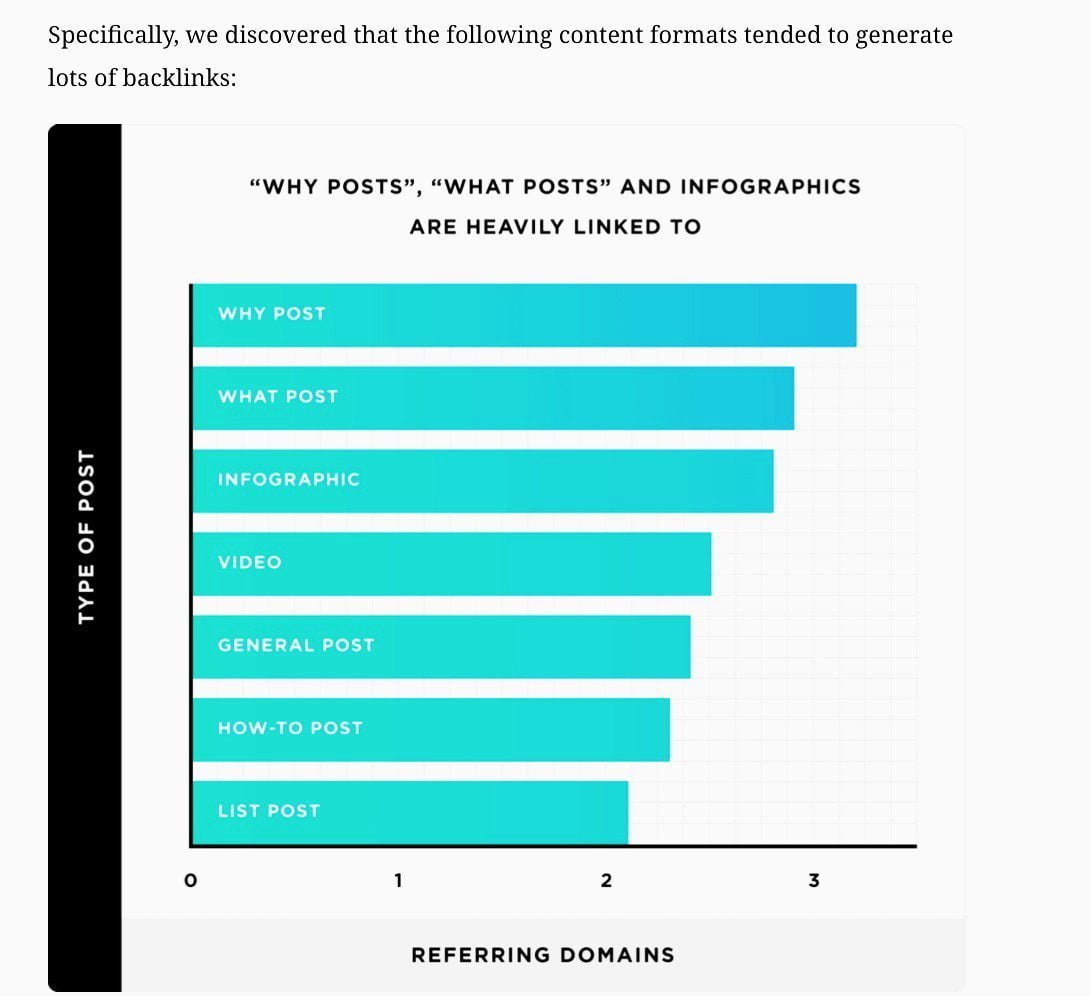
Their analysis suggests that people are more likely to link to “Why” and “What” posts, and infographics than videos and “How-to” posts.
● Find broken backlink opportunities on related quality sites
Another way to build links to your content is to search for broken backlink opportunities on related pages on authority websites.
If the content no longer exists, you can write them and offer your link as a good replacement.
Three things are happening here:
First, you’ve brought to their attention a situation that could affect their traffic.
Second, you’ve proffered a solution at no cost to them.
And third, you’re helping them update their site, which can improve their traffic.
Because it is a win-win situation, many people will be pleased to take up your offer, and simply add a link to your page.
● Spy on your competitors’ backlinks
Like you did with keywords in Step 2 of this article, you can fish for backlink opportunities on your competitors’ sites.
Simply enter a top competitor’s result into a backlink checker tool, and it will show you their backlink records, including the referring domains.
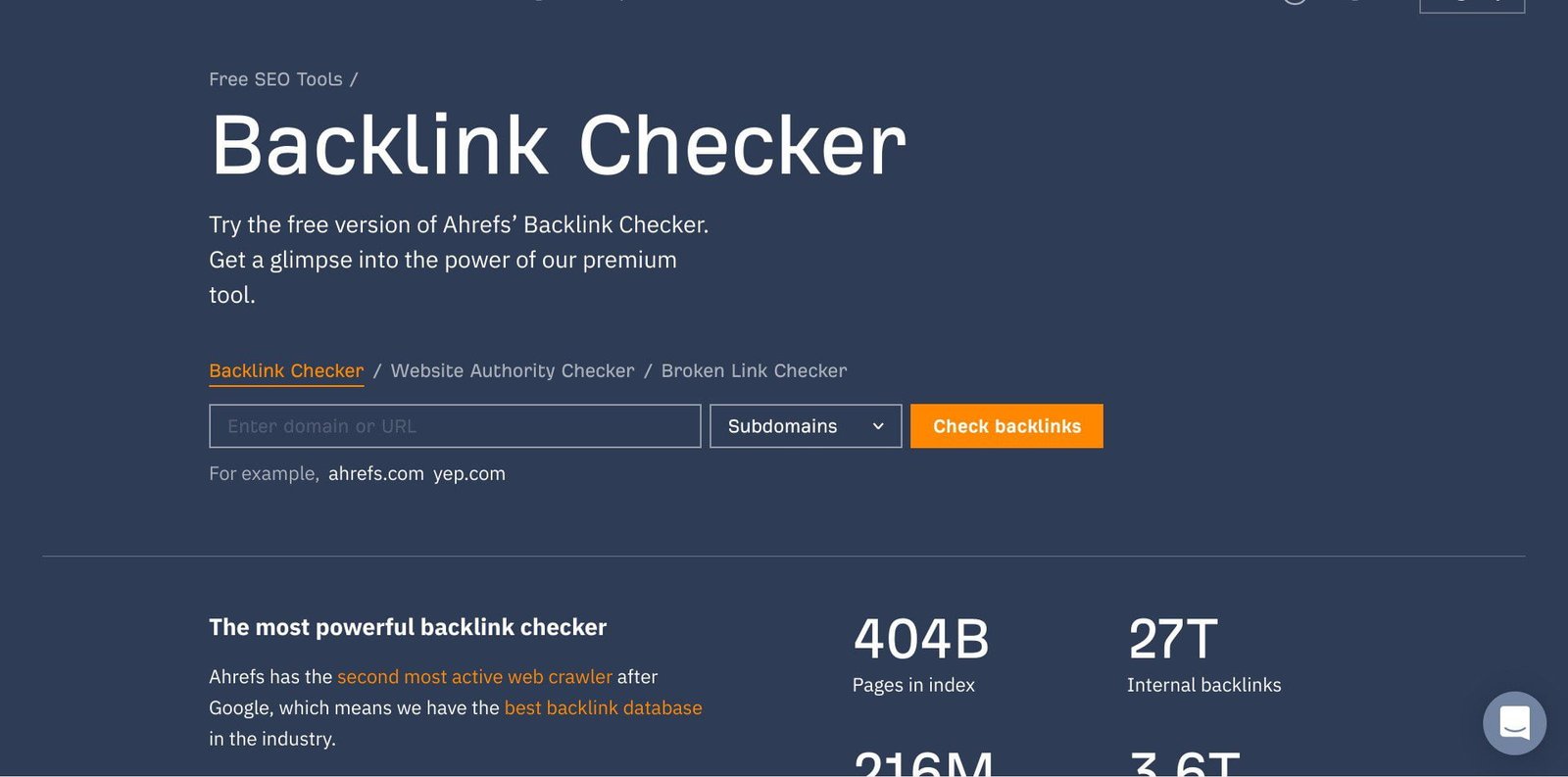
Then, you need to painstakingly go through these domains to find possible prospects for your similar content.
This strategy isn’t to offer your content as an alternative to your competitor’s.
Rather, you’ll be looking for a chance to be added to a list or a specific place on their page where it makes sense.
❼ Invest in A Good Content Design
Content design is simply how you organize and serve your rich information to readers.
And in today’s world, presentation matters.
For example, how an expert chef serves his delicious meal matters a lot.
It isn’t enough to spend time and resources creating satisfying content; you should also invest in a simple design to deliver your content in a presentable, engaging, and easy-to-understand way.
A good design draws readers in to explore your pages (and website) and allows them to easily access the information they want.
This will reduce user bounce rate and increase user dwell time on your site.
And when users love your content, they’ll tell others about it.
Once search engines see more visitors spending more time with your content, they’ll rank your results higher.
This means that a good content design can influence the choice of pages (and websites) for higher rankings in search results.
So:
If content is king, quality design is the kingmaker.
Just like no king can enthrone himself, content cannot be king by itself.
As kings are enthroned by kingmakers, so is high-quality content by quality design.
If you present your well-written content in a difficult-to-read manner, users will abandon your site and go to your competitors.
In other words, your design can make or break your content.
So again, in a situation where two pages have similar quality content, content appeal can be the deciding factor.
In fact, as part of its quality rating test, Google usually checks the features and functionality of a page, to see whether they’re user-friendly.
So, for your SEO strategy to be effective, it must include a good design that makes your text easy to read, and the features easy to use.
Where it makes sense, your design can include the following − especially if it will help people understand the text better:
✓ Original images
✓ Screenshots
✓ Charts and graphs
✓ Diagrams
✓ Blog post banners
● Make sure your design is mobile-friendly

If your design isn’t mobile-friendly, mobile searchers will find it difficult to view and use your site.
That means you’ll be losing a large percentage of your audience.
Statistics show that in most parts of the world, more people access the web using a smartphone than any other device.

This is why Google established its mobile-first policy, to index and rank mobile-friendly websites higher in SERP in 2019.
This policy actually took off in 2015.
Now mobile-first indexing is enabled automatically for all brand-new sites and websites that Google has yet to discover and index.
So, if you want to compete for first-page ranking, you need to invest in a mobile-friendly design from the get-go.
✓ Ensure that your visitors can easily complete all tasks on your site in a few clicks. Whether it is reading your articles, watching videos, checking reviews, filling out contact forms, purchasing products, or playing a game.
✓ Make sure your design adjusts nicely on various screen sizes, most especially mobile.
✓ Measure the effectiveness of your site by how easily mobile visitors can complete common tasks.
If you’re using WordPress, you want to choose a responsive theme as the foundation of your site design.
✓ Make sure you have the same amount of content for all devices and that it renders well on mobile.
Most CMSs have a Preview feature in their edit screen that allows you to view your content on different devices during the building stage.
You can also use Google’s Lighthouse tool to test your design’s responsiveness on mobile devices.
In fact, you can check if your entire site is mobile-friendly with this tool.
❽ Optimize for Quality User Experience (UX)
Optimizing your site for quality user experience is also very key to the success of your SEO strategy.
Again, Google says it will always rank pages with the best information overall, even if some aspects of page experience are below standard.

However, Google wants you to write a satisfying amount of high-quality content and deliver an amazing user experience.
From a research, Google found that users prefer sites with a great page experience.
So Google says in situations where several pages have similar relevant content, page experience becomes the “tie-break” ranking signal that determines their positions in Search.
It, therefore, means that pages with useful content and great page experience will always outrank pages with helpful information but poor user experience.
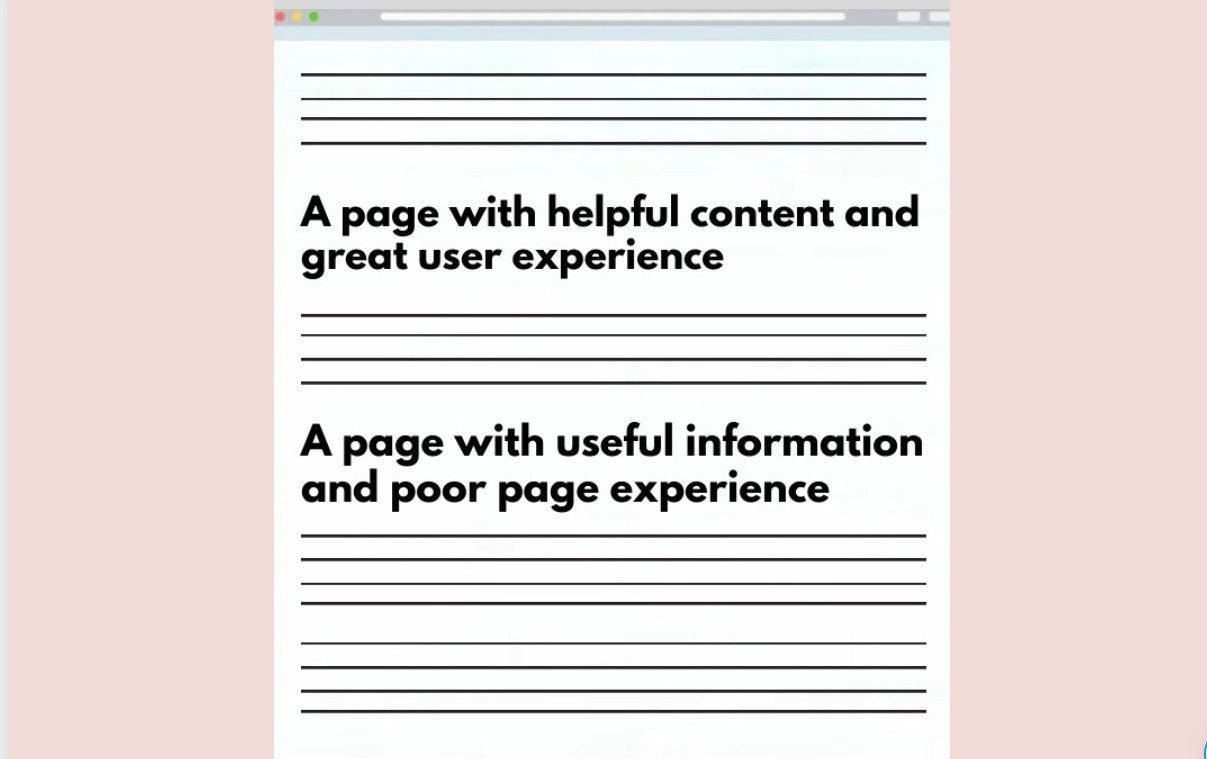
Simply put, page experience is one of the many signals that Google uses to rank pages.
So, once you create high-quality content and optimize it for SEO, you need to work on your page performance metrics to make sure that users have a great UX on your pages.
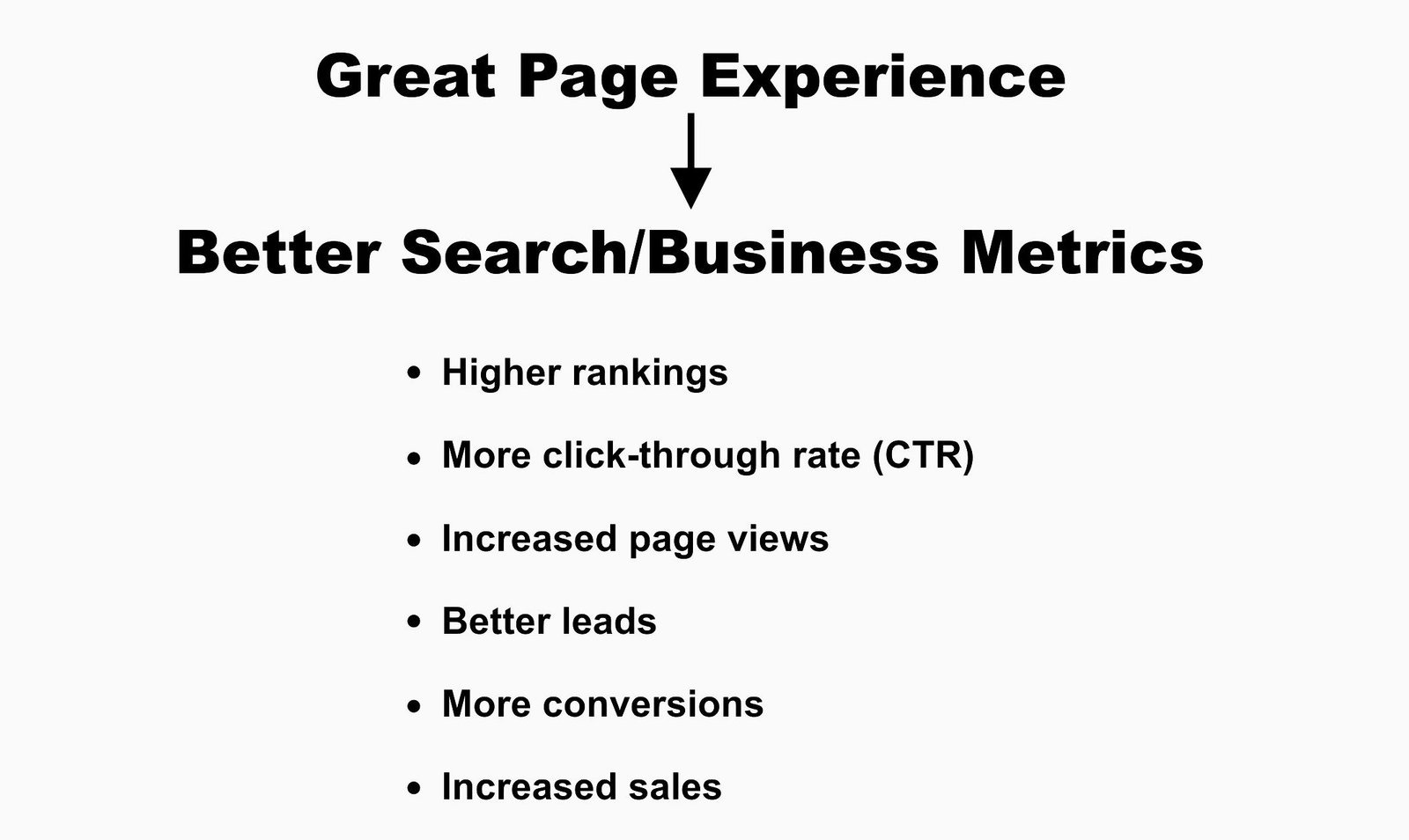
A great page experience will improve user engagement, which means better search and business metrics – higher rankings, more clicks, more page views, better leads, more conversions, and more sales.
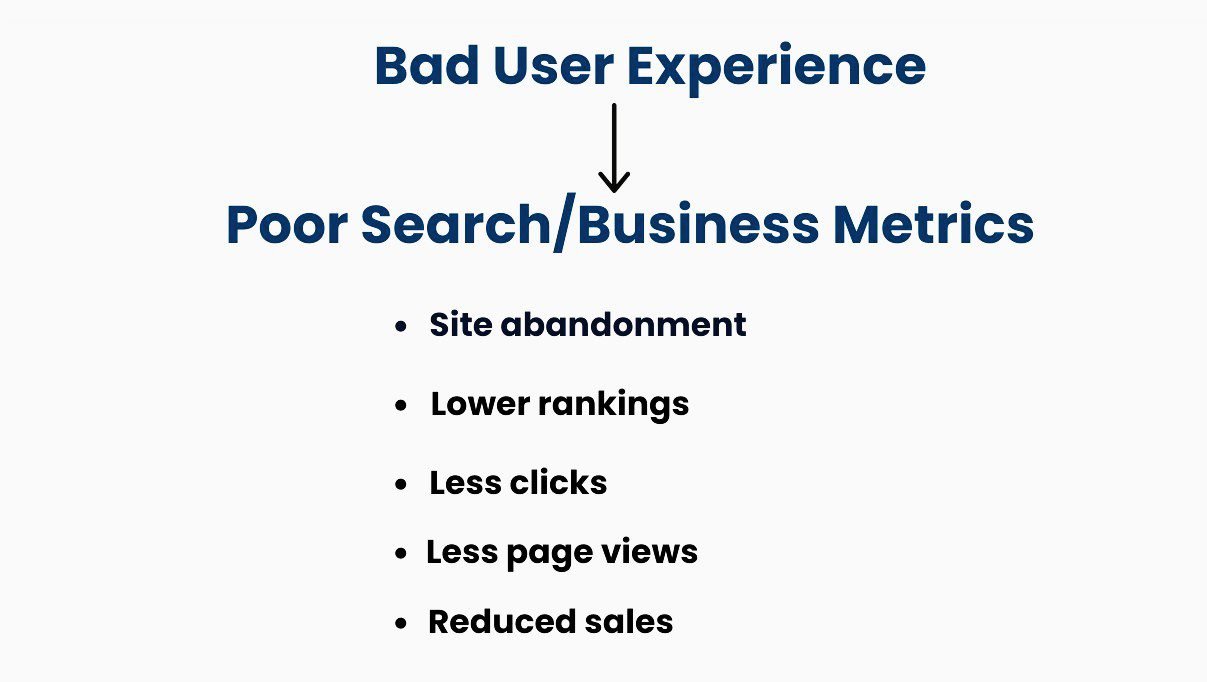
On the other hand, a bad page performance can badly affect user experience with your content.
This can lead to site abandonment (or “pogo–sticking”), lower rankings, fewer clicks, reduced sales, etc.
The following signals are currently essential to delivering a good page experience in Google Search.
So if you get these components right, they can help you achieve your search and business goals.
Let’s a look at them one by one.
● Core Web Vitals
Core Web Vitals are a critical part of page experience signals.
They are a set of user-centered metrics used to measure how quickly a website responds to search queries and the quality of user experience on mobile and desktop in real life.
Currently, Core Web Vitals cover 3 areas: load time, interactivity, and visual stability.
Loading performance is the perceived load speed and the time it takes a page’s main content to load. measured by Largest Contentful Paint (LCP).
Interactivity is how quickly the page responds to user interactions. It is measured by Interaction to Next Paint (INP).
And content stability is how much unexpected disruptions users experience when the page is loading. It is quantified by Cumulative Layout Shift (CLS).
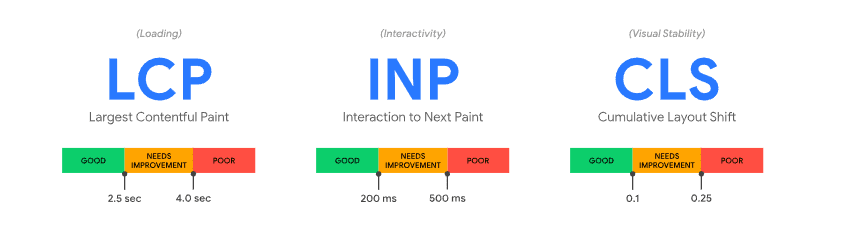
User experience for each metric can be “Good”, “Needs Improvement”, or “Poor” and is applied to a page’s URL on both mobile and desktop.
The better your Core Web Vitals, the higher your chances of climbing up in search results, and the longer users stay engaged with your quality content.
This will ultimately have a huge impact on your business metrics.
The best part? You don’t have to be an expert to understand how to optimize the quality of (UX) on your pages.
Google regularly updates several of its tools to help even non-techy site owners easily measure and analyze their website’s UX, diagnose and fix issues, and improve their Core Web Vitals score.
They include:
▹ PageSpeed Insights (PSI) testing tool − helps you to assess your performance, one page at a time.
▹Chrome Lighthouse tool − helps you to improve the quality of web pages.
▹ Search Console (Core Web Vitals report) − shows you critical metrics on the quality of user experience on a bunch of pages and identifies areas you need to improve.
● Mobile-friendliness
Mobile friendliness is the second critical signal of page experience that can influence your rankings.
Again, statistics suggest that more web searches originate from smartphones in different parts of the world today (Statcounter).
So, Google uses a “mobile-first indexing” structure to index and rank pages, and display snippets in its search results.
In other words, only pages (and websites) well optimized for mobile stand a chance of ranking in SERPs – even when the search is initiated from a desktop (that is if you have a single URL for all devices).
So, make your site mobile-friendly site.
Make sure its content displays perfectly well on both mobile and desktop without readers needing to zoom, double-tap, or pinch their screen before they can view it.

Users should also be able to complete all the tasks they want to do on their mobile phones and on other devices.
● HTTPS-security
For years, Google has been at the forefront of keeping the web safe. It has been pushing for all websites to be protected by strong HTTPS (Hypertext Transfer Protocol Secure) encryption.
In August 2014, HTTPS became a ranking factor. And in 2020, Google included it as a critical part of its page experience signals.
Because hundreds of thousands of websites get compromised every day.
These hacks can breach your site if not well protected, like planting a harmful code to collect your visitors’ keystroke data, stealing logins for online banking, and more.
HTTPS is the primary layer of security for any website today.
If you look at any first page of SERP, you’ll notice that all the pages are served over HTTPS − with a locked padlock symbol confirming this.

Because search engines want to make sure their users visit only secure websites.
So, to improve the quality of user experience on your site, make sure your pages are encrypted.
Check if your site’s connection is secure to boost your ranking chances.
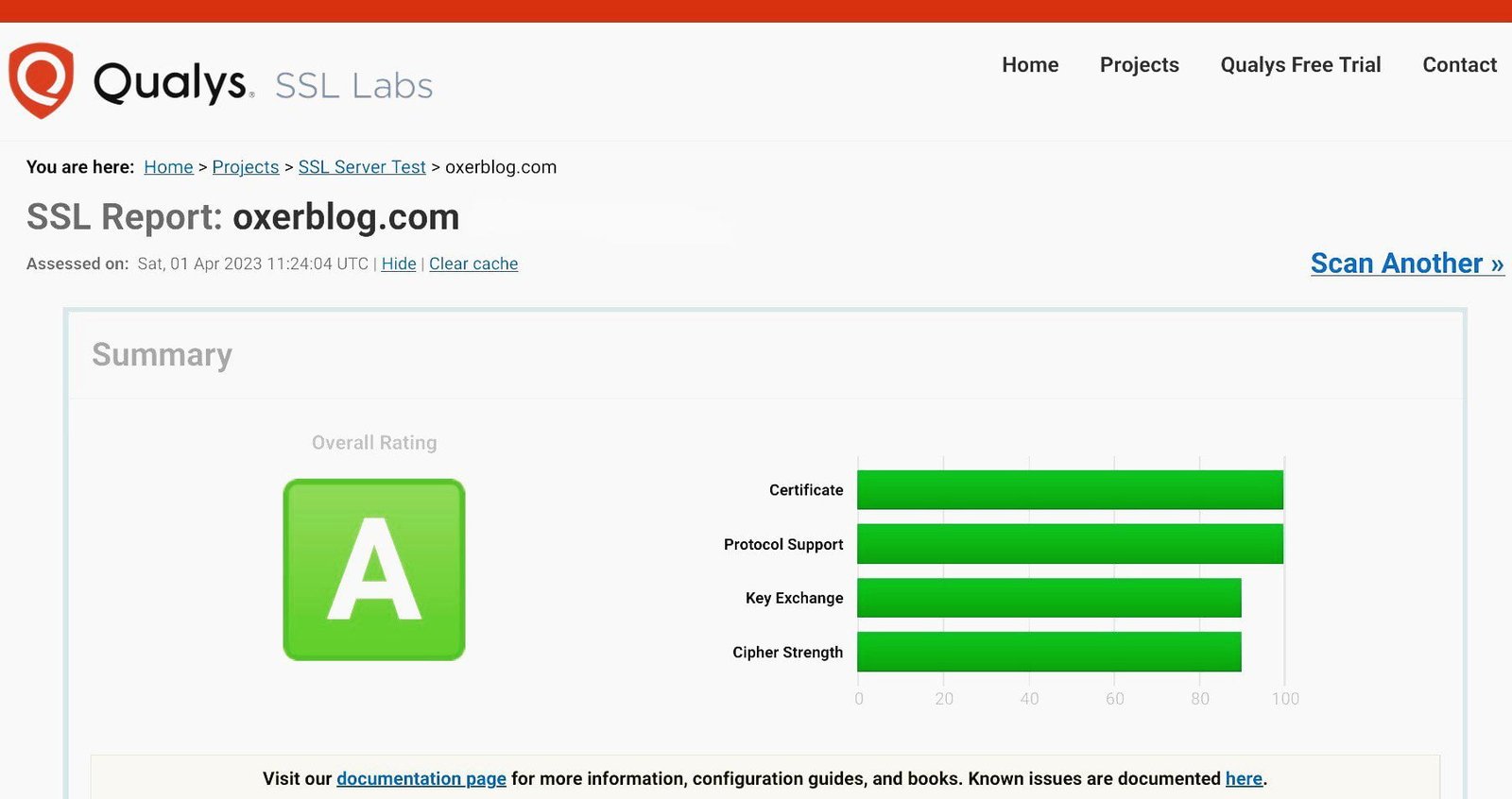
You can test your website’s security level and configuration using Qualys SSL Labs tool.

For example, below is my site’s SSL report:
● No intrusive interstitials and dialogs
Intrusive interstitials and dialogs are the last of the four signals that make up the page experience.
Basically, they are obstructive pages that pop up before or after a page displays, and in the process, interfere with users having a seamless experience with its main content.
Interstitials are full-page overlays while dialogs are partial-page overlays.
Users usually find obstructive dialogs and interstitials annoying and simply abandon the site.
This will lead to an increase in your bounce rate.
Search engines also may have difficulty understanding your content, which can affect your search rankings and traffic.
If you need to use these types of ads, then create unobtrusive dialogs that won’t make your content difficult to use.
Also, instead of full-page interstitials, use small banners in between your content, in places where it makes sense.
The bottom line is to make your main content easily distinguishable from ads, easily accessible, and easy to use.
❾ Constantly Evaluate and Fine-Tune Your SEO Strategy
Your SEO strategy isn’t cast in stone.
Google frequently updates its algorithms to help bloggers and website owners optimize their sites and pages better to improve their SEO rankings.
So, for your strategy to remain effective, you should regularly assess its performance, and adjust it to align with Google’s ever-changing algorithms.
Thankfully, you have Google Search Console to constantly monitor key user and business metrics, and evaluate how effective your SEO strategy is, and what improvements you need to make.
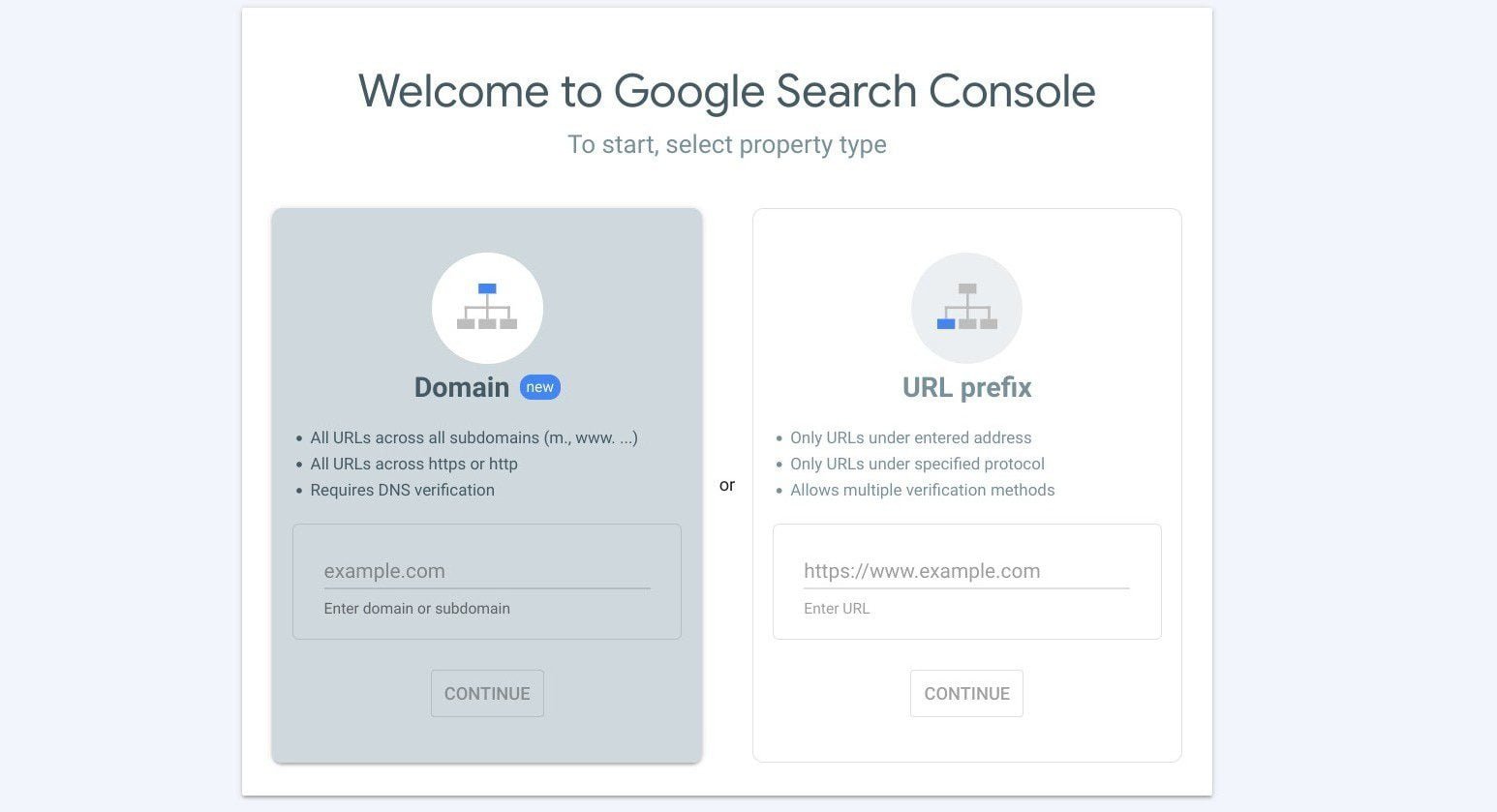
So, add your website to Google Search Console from the get-go.
It is a complete package of a site’s performance in Google Search on mobile and desktop, including where and what you need to improve.
Review your pages’ search report, say, every month. Keep track of important metrics such as organic traffic, keyword rankings, browsing sessions, pageviews, backlinks, and bounce rates.
With that said, large traffic won’t be thronging your website overnight. The impact of your SEO strategy will be gradual.
The important thing is the consistent progress you are making, day after day, week after week, year after year.
Frequently Asked Questions (FAQs)
● What are the 5 top SEO strategies?
The 5 top SEO strategies include:
1. Choose a niche in which you have adequate experience or expertise.
2. Find out your readers’ keywords and more importantly, the intent behind their queries.
3. Select the queries you can answer well and create a satisfying amount of high-quality content that best satisfies search intent.
4. Apply on-page and off-page SEO techniques including unique URLs, title tags, title links, meta descriptions, and backlinks.
5. Invest in a good quality design and optimize user experience on your site.
Conclusion
No website can rank high in organic search results by a stroke of luck.
You’ll need to deliberately create and implement a robust SEO strategy to improve your site’s visibility in search engines.
This should be one of your major goals this year.
With this comprehensive, step-by-step guide, you can develop a solid SEO strategy to grow your website’s traffic and income.
And you never can tell, you might just become the next big thing online!
There you have it – how to develop an effective SEO strategy in 2024.
Hope this guide helped you learn how to create an effective SEO strategy to grow your traffic.
You should also see my article on 27 simple SEO best practices recommended by Google, to learn more about search engine optimization.
If you like this article, please help me spread the word among your friends. Thank you!